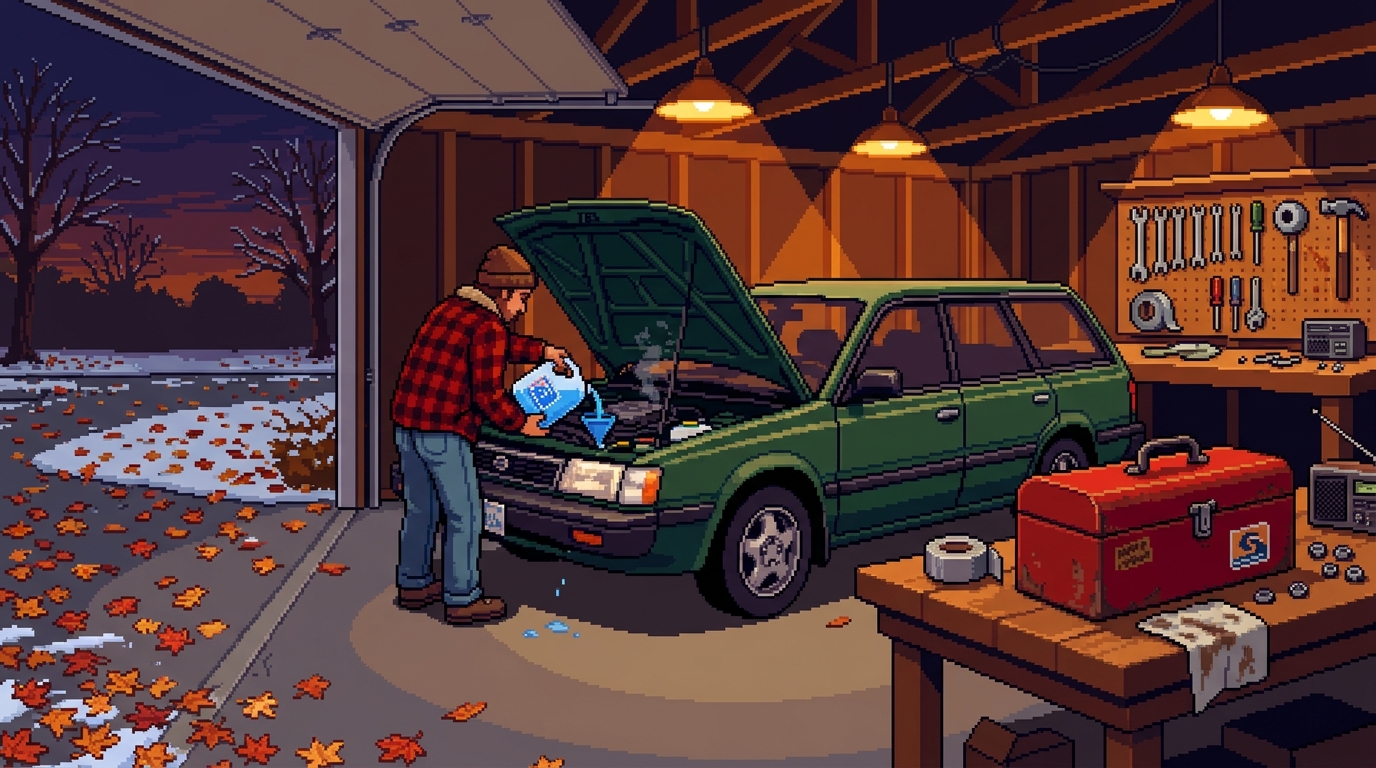
If you are like ninety percent of drivers across North America, you probably think about windshield washer fluid roughly as often as you think about the air inside your spare tire.
You pull into a quick-lube shop or dealership service bay for a routine autumn oil change. On your itemized invoice, right between the fresh synthetic oil and the complimentary tire pressure check, sits that comforting little line item: "All Under-Hood Fluids Inspected & Topped Off (FREE)."
You drive home happy. Your reservoir is full. You don't give it another thought.
Then comes the first freezing November morning. You merge onto the highway behind an 18-wheeler kicking up a blizzard of brown road slush, salt brine, and grime. Your windshield turns into an opaque brown sheet. You pull the washer stalk expecting a crisp spray.
Instead, you hear a sickening, metallic hiss-crunch under your right fender, followed by dead silence.
No spray. Zero visibility at 65 mph (105 km/h).
What just happened? That "free" top-off at the lube shop filled your tank with cheap summer bug wash that froze solid into an eight-pound block of ice, cracking your washer pump clean in two. And to replace that $35 plastic pump, a mechanic will have to tear off your entire front bumper—handing you a $350 invoice for five dollars worth of bad fluid.
Key Takeaways (Quick Summary):
* The "Free Top-Off" Ambush: Quick-lube shops frequently use cheap summer-blend "Bug Wash" (which freezes at 32°F / 0°C). When winter cold snaps hit, ice expands by 9%, shattering submerged pumps and splitting plastic tanks inside your front bumper.
* The High-Speed "Flash Freeze": You cannot rely on "All-Season (-20°C / -4°F)" fluid on freezing highways. At 65 mph, wind chill and alcohol evaporation instantly drop glass surface temperature, turning weak washer fluid into a sheet of solid ice across your windshield in two seconds.
* The Orange & Blue Slime Reaction: Mixing water-beading fluids (like orange Rain-X) with traditional blue alcohol fluids causes "emulsion breakdown." The silicone polymers collapse into a sticky, curdled slime that permanently chokes pump filters and fries electrical fluid sensors.
* The Tap Water Biohazard: Topping off with garden hose or tap water ruins your car three ways: it freezes instantly in autumn, coats fine spray nozzles in calcified mineral scale, and breeds dangerous Legionella bacteria in hot engine bays.
* The 3-Minute October Flush: Before sub-zero weather strikes, drain or spray out remaining summer liquid, pour in a full jug of rated -40°C (-40°F) or -45°C Extreme Winter De-Icer, and never pour hot water onto frozen glass.
* The Smart Paper Trail: Logging your seasonal fluid swaps and shop invoices in AutoLog eliminates blind spots and proves your vehicle was maintained with zero shortcuts.
The "Free Top-Off" Ambush: Why You Don't Notice Until It's Too Late
Why does virtually no one consciously buy or manage their own washer fluid until disaster strikes?
Because quick-lube franchises (Mr. Lube, Jiffy Lube, Valvoline) and dealership service bays have trained drivers into total apathy. Every time you get an oil change, a technician reaches for an overhead dispenser hose attached to a 55-gallon industrial drum and tops off your translucent white plastic reservoir.
Here is the dirty secret of automotive fleet supply: bulk summer fluid is dirt cheap.
A barrel of summer-grade detergent wash costs a shop pennies per gallon. It contains water, blue dye, and a trace amount of surfactant engineered to dissolve insect splatters. What it does not contain is methanol or ethanol.
If you had your oil changed in July, August, or late September, your washer reservoir is likely ninety percent full of liquid that turns into an ice cube the split second ambient temperatures dip to 32°F (0°C).
In modern vehicle architecture (Honda, Toyota, Subaru, Volkswagen), automotive engineers no longer mount the washer tank high up on the passenger firewall where engine heat can gently thaw it out. To maximize engine-bay crash crumple zones and aerodynamics, the reservoir is wedged down inside the cavernous cavity behind your front bumper cover, directly in front of the wheel well liner.
It sits in a freezing wind tunnel. It receives zero radiant engine heat. When summer fluid freezes inside that low-mounted tank, the water expands by roughly 9% in volume. That expansion exerts hundreds of pounds of hydraulic pressure against the submerged electric pump housing and the plastic seam welds. The pump casing cracks, the internal impeller binds, and the second you pull the stalk on the steering column, the electric motor draws locked-rotor amperage and burns out its internal windings.
When you take it to a repair shop, the technician has to hoist the car, pull the front wheels, remove 14 plastic underbody push-pins, drop the front fascia, and replace the assembly. A $35 OEM pump turns into a $300 to $400 labor charge—all because of "free" fluid.
The Great Color Myth: Why "Blue vs. Orange" Is a Dangerous Gamble
When drivers do finally walk into an auto parts store or gas station to buy a jug, they almost always rely on visual shorthand: "Blue means standard winter, orange means fancy summer, right?"
Relying on color is the single most dangerous gamble you can make.
There is zero federal, SAE, or industry standardization governing the dye used in automotive washer fluids. Liquid color is purely a marketing decision:
* The Deceptive "Blue": While blue has historically represented winter solvent, dozens of economy brands sell 0°C (32°F) summer bug wash in identical bright blue liquid. If you grab the $2.49 blue jug on a gas station forecourt pallet without reading the fine print, you are pouring summer water directly into your winter tank.
* The "Orange" Paradox: Premium brands like Rain-X use orange for both their -30°C (-22°F) All-Weather De-Icer and their 0°C (32°F) Summer Bug & Tar Remover.
* Purple & Pink: Often reserved for extreme sub-zero commercial de-icers rated for -45°C to -50°C (-49°F to -58°F).
* Green & Yellow: Typically formulated for summer pollen and tree sap removal.
The Golden Label Rule: Ignore the color of the jug entirely. Look for the large, bold temperature rating printed across the bottom third of the label. In Canada and the northern US Salt Belt, if the jug does not explicitly state -40°C (-40°F) or lower, leave it on the shelf.
Chemical Warfare in Your Reservoir: Why Mixing Orange and Blue Creates Slime
Every autumn, thousands of well-meaning DIYers make a catastrophic chemical mistake: their reservoir is half-full of standard blue shop fluid, and they decide to treat their car to a jug of high-end orange water-beading fluid (like Rain-X). They pop the hood, dump the orange fluid directly on top of the blue, and slam the hood shut.
Within two weeks, their washer spray turns into a pathetic dribble, then dies completely.
What happened? You triggered emulsion breakdown in your tank.
High-performance water-beading fluids rely on microscopic silicone or siloxane polymer emulsions suspended in solution. These hydrophobic polymers are designed to transfer onto your windshield glass and form a low-surface-energy coating that causes raindrops to bead up and roll off at highway speeds.
However, keeping silicone polymers evenly dispersed in water requires a very delicate balance of specialized surfactants and specific alcohol concentrations.
When you dump that chemical formula into a reservoir containing generic blue fluid (which uses aggressive anionic detergents, unbuffered tap water, and varying concentrations of methanol), the chemical equilibrium collapses. The polymers fall out of suspension.
Instead of remaining a liquid, the mixture undergoes phase separation, coagulating into a white, gooey, petroleum-jelly-like slime.
This gelatinous sludge settles to the lowest point of the tank—which is precisely where the fine mesh intake strainer of your electric washer pump sits. The gel coats the screen, starving the pump of fluid. Worse, tiny globules of slime get sucked into the lines, permanently clogging the microscopic laser-cut fan nozzles mounted on your hood or wiper arms. Poking them with a safety pin won't clear silicone sludge; the entire fluid circuit has to be dismantled and flushed with scalding hot isopropyl alcohol.
The $250 European Sensor Nightmare (VW, Audi & Subaru)
If you drive a modern German or Japanese vehicle equipped with a digital "Low Washer Fluid" dash alert, the consequences are even more infuriating.
These vehicles do not use a mechanical float ball in the reservoir. Instead, they use a conductance sensor consisting of two bare metal prongs submerged in the fluid. The vehicle’s Body Control Module (BCM) constantly passes a micro-current between the two pins; as long as the fluid conducts electricity, the computer knows the tank is full.
When water-beading silicone fluids or coagulated polymer mixtures enter the tank, the silicone coats the metal sensor pins with a microscopically thin, non-conductive insulating layer.
The electrical circuit breaks. Your dashboard computer instantly flags an error, chiming and displaying a bright amber "Washer Fluid Low" warning on your gauge cluster every single time you start the car—even when the tank is overflowing with fluid.
Dealership service advisors see this weekly. The fix? Removing the inner wheel arch liner, pulling the sensor, and scrubbing the prongs with steel wool and brake cleaner, or replacing the sensor entirely for $200 in shop labor.
The Tap Water Temptation: Scale, Sludge, and the 9% Expansion Trap
We have all seen someone standing in their driveway with a garden hose, filling their washer reservoir to the brim with plain tap water. It seems harmless, free, and intuitive.
In reality, running plain tap water through your vehicle's washer system is mechanical malpractice for three scientific reasons:
1. The 9% Volume Expansion Fracture
Water is one of the only chemical compounds on Earth that expands when transitioning from liquid to solid. At 32°F (0°C), water expands by roughly 9%. In a sealed plastic bottle or a rigid washer reservoir, that expansion generates up to 25,000 to 30,000 PSI of internal pressure. Plastic cracks instantly. Rubber feeder hoses pop off their barbed fittings. When you finally thaw out in spring, the first time you spray, five quarts of fluid pour straight onto your engine skid plate.
2. The Calcified Arteries (Limescale Clogging)
Municipal tap water and well water are rich in dissolved calcium carbonate, magnesium, and mineral salts. In the summer heat, under-hood temperatures reach 160°F to 180°F (70°C to 82°C). Every time your engine heat-soaks, water sitting in the tiny rubber delivery lines and nozzle tips evaporates, leaving behind rock-hard mineral crust (scale). Over a few seasons, those precision spray jets—designed to deliver an aerodynamic fan across your windshield—turn into calcified, spitting dribbles.
3. The Bacterial Biohazard in Your Air Vents
In 2010, the UK Health Protection Agency (HPA) conducted a landmark clinical epidemiological study investigating sporadic outbreaks of Legionnaires' disease (a severe, potentially fatal bacterial pneumonia caused by Legionella pneumophila).
The researchers uncovered a shocking statistical correlation: drivers of commercial vans and passenger cars who used plain tap water in their windshield washer reservoirs were five times more likely to contract Legionnaires' disease than drivers who used commercial washer fluid containing alcohol and biocides.
Why? Warm, stagnant tap water sitting in a dark engine compartment at 90°F to 120°F provides the ideal incubation incubator for aquatic bacteria. When you spray your windshield while waiting at a red light, the aerosolized mist is sucked straight into the vehicle’s cabin air intake below the cowl, blowing live bacterial spores directly into your lungs. Commercial washer fluids contain alcohols and detergents that act as powerful biocides, preventing bacterial colonization entirely.
Highway Blindness: The Physics of "Flash Freeze" at 65 MPH
Perhaps the most common question among drivers in moderate coastal climates (like Vancouver, Seattle, or Portland) is: "Why can't I just buy All-Season fluid rated to -20°C (-4°F) and use it year-round?"
On paper, a -20°C rating sounds like more than enough protection for a winter where temperatures rarely drop below -5°C (23°F).
In practice, driving on a highway completely invalidates static temperature ratings.
When you are cruising at 65 mph (105 km/h) in freezing weather, two thermodynamic processes occur simultaneously the instant washer fluid strikes your windshield:
1. Forced Convective Cooling (Wind Chill): The sheer volume of sub-freezing air stripping over your laminated glass windshield drastically drops the surface temperature of the glass below the ambient air temperature.
2. Evaporative Latent Heat of Vaporization: Winter washer fluid is a mixture of water and volatile alcohol (typically 30% to 40% methanol). When sprayed across a windshield into a 65 mph gale, the alcohol has a far lower boiling point and higher vapor pressure than water. The alcohol evaporates almost instantaneously into the rushing slipstream.
As the alcohol evaporates, it pulls massive amounts of thermal energy (latent heat) off the glass surface.
What is left behind? The remaining water.
With the alcohol gone and the surface chilled, that remaining water undergoes an instantaneous phase change known as Flash Freeze.
Within two seconds of pulling your wiper stalk, your entire windshield turns into a frosted sheet of opaque, white ice. Because your wiper blades are cycling back and forth, they simply smear this slushy glaze into a solid translucent barrier.
You are traveling at 100 feet per second, surrounded by commuter traffic, completely blind.
This is why experienced cold-climate drivers and professional mechanics never settle for "-20°C All-Season" fluid in the winter months. You need an aggressive, surplus methanol concentration (-40°C to -45°C) to ensure that even after aerodynamic evaporation takes its cut, the remaining fluid still contains enough chemical freezing-point depression to stay liquid and sweep clean.
The Safe & Smart 3-Minute October Reset (And Why Hot Water Kills Glass)
Preparing your vehicle’s washer system for winter is one of the easiest, cheapest five-minute maintenance rituals in automotive care. Do not wait for the first sub-zero blizzard. Execute this simple checklist before October ends:
October Washer System Prep Checklist:
- Step 1 — Purge: Spray out or siphon any remaining unknown summer fluid until the reservoir is completely empty.
- Step 2 — Inspect: Check spray nozzles for calcified white mineral crust and wipe them clean.
- Step 3 — Charge: Pour in a fresh gallon of genuine -40°C or -45°C winter-rated de-icer fluid.
- Step 4 — Prime: Hold the washer stalk for 10 consecutive seconds to flush old fluid and water entirely out of the feed lines and pump.
1. The Purge
Before pouring in premium winter de-icer, get rid of whatever mystery brew is currently in your tank. Sit in your driveway, turn the car on, and run the washer pump in 5-second bursts (allowing the pump motor to rest between bursts so it does not overheat) until the fluid level warning illuminates or the spray runs dry. This prevents the chemical incompatibility sludge that occurs when mixing different polymer brands.
2. The Full Charge
Head to Canadian Tire, an auto parts store, or a warehouse club and grab a four-pack of -40°C (-40°F) or -45°C Winter De-Icer. Pour the entire gallon into the reservoir. Keep an extra sealed jug in your trunk organizer. In severe winter storms, road grime and salt brine consumption can deplete an entire tank in a single three-hour road trip.
3. Prime the Long Lines
Once the fresh -40°C fluid is in the tank, you must cycle the system. Press and hold the washer stalk until you clearly see the new, strongly scented fluid spray out of both front nozzles. If your vehicle has a rear window wiper or headlight washers, run them until the fresh fluid reaches the back glass. The fluid lines leading to your rear hatch are often 15 to 18 feet long; if you leave old summer water trapped inside that rear line, it will freeze, expand, and blow the rubber hose connection off inside your headliner, dumping washer fluid all over your interior carpet.
The Fatal Shortcut: Why You Must NEVER Pour Boiling Water on a Windshield
Every winter, social media circulates "life hacks" showing drivers pouring a kettle of boiling water over a frosted windshield to instantly melt the ice.
Never, under any circumstances, pour hot or boiling water onto automotive glass.
Automotive windshields are made of laminated safety glass—two layers of annealed glass bonded together by a central polyvinyl butyral (PVB) plastic interlayer.
When you dump 180°F (80°C) water onto 20°F (-7°C) glass, you induce violent differential thermal expansion. The outer glass layer expands rapidly while the frozen inner layer remains contracted. That instantaneous mechanical stress overwhelms the tensile strength of the glass, creating an explosive crack that tears across the entire width of your windshield in milliseconds.
You turn a three-minute scraping job into an immediate $800 to $1,500 windshield replacement bill—and on modern cars equipped with Advanced Driver Assistance Systems (ADAS), replacing that glass requires an additional $400 camera recalibration scan.
Use your vehicle's engine defroster, a brass-blade ice scraper, or genuine de-icer spray. Leave the kitchen kettle on the stove.
Bridge the Carfax Gap: Keeping Your Preventive Paper Trail Clean
Modern vehicle care isn't just about turning heavy wrenches on suspension links or rebuilding engines. True automotive longevity is built on meticulous system discipline—knowing what fluids went into your vehicle, when they were serviced, and keeping your systems operating at factory peak.
The tragedy for hands-on owners is the "Carfax Gap."
When you spend your hard-earned time swapping seasonal fluids, flushing your washer circuits before winter, replacing worn wiper inserts with OEM silicone refills, and inspecting hoses, none of that diligence gets registered on a corporate Carfax report.
When you decide to sell your vehicle privately five years down the road, prospective buyers are terrified of hidden electrical gremlins, corroded wiring, and neglected maintenance.
AutoLog bridges that gap.
With AutoLog, you can document your vehicle’s full preventive maintenance record in seconds:
* Log Seasonal Transitions: Record your seasonal wheel changeovers, washer system winterization, and wiper blade replacements.
* Store Fluid Invoices & Specs: Snap high-resolution photos of your parts receipts, capturing the exact fluid specifications and temperature ratings used.
* Track Mileage Milestones: Maintain an unbroken digital chronology that proves to future buyers that your car was guarded against cold-weather neglect.
When it comes time to hand over the keys, you don't offer vague promises or hand over a shoebox of faded thermal receipts. You provide a verified, clean AutoLog Vehicle Health Report proving that your vehicle was treated with the highest degree of mechanical respect from bumper to bumper.
Call to Action
Stop treating your washer fluid as an afterthought. Go pop your hood today, check the fluid rating in your reservoir before the first freeze catches you blind, and start tracking your true vehicle maintenance on AutoLog at sukiwave.com. Take control of your car’s health—and never get caught blind at 65 mph again.
Legal Disclaimer: Automotive maintenance involves inherent risks of chemical exposure and cold-weather hazards. Windshield washer fluids contain concentrated methanol, which is highly toxic, flammable, and hazardous if ingested, inhaled, or absorbed through the skin. Never siphon washer fluid by mouth, never use open flames near fluid containers, and keep all automotive chemicals strictly out of reach of children and household pets. Never apply boiling water or extreme localized heat to automotive glass. Always consult your vehicle's factory owner's manual for approved fluid capacities, nozzle specifications, and safety guidelines. AutoLog, Sukiwave LLC, and its contributors assume no liability for cracked reservoirs, damaged pumps, thermal glass shock, or improper chemical handling.