
Every winter across the northern snow belt, thousands of drivers find themselves stranded in a familiar, frustrating trap: pulling out of a driveway or sliding off a slick shoulder, only to feel the car grind to a halt in deep powder.
Panic sets in, cold air bites through the windshield, and the first instinct is almost universal.
You stomp the gas pedal to the floor.
The engine screams toward the redline, snow flies thirty feet behind the bumper, and the speedometer climbs to 50, 60, or 70 mph. Many drivers assume that aggressive wheelspin generates enough friction to melt the snow down to bare asphalt.
Instead, within thirty to sixty seconds, that furious spinning creates a smooth cradle of polished ice, burns through expensive drivetrain components, and in the worst cases, causes the spinning tire to violently explode.
The 30-Second Truth About Spinning Wheels in Snow:
- Why do spinning tires explode in snow?
Because of how standard open differentials work, when one wheel is immobilized in snow, all engine torque is routed to the spinning wheel at twice the speed shown on your speedometer. If your dashboard reads 45 mph, that spinning tire is actually rotating at 90 mph. Winter tires are not built to withstand the extreme centrifugal force of triple-digit rotational speeds while stationary, causing the tread and steel belts to tear apart. - How does floorboarding damage the differential?
The small spider gears inside an open differential are engineered only for brief, low-speed differentiation during turns. When one wheel spins at hyper-speed while the other sits motionless, the tiny pinion cross pin experiences brutal friction and oil starvation. Within seconds, the pin can weld itself to the gears and shatter the entire differential housing. - Why doesn't wheelspin melt through snow to the pavement?
High-speed spinning creates flash friction that melts the surface of the snow for a fraction of a second. In freezing ambient air, that thin layer of moisture instantly re-freezes into a slick, polished sheet of glaze ice with virtually zero traction.
The 2x Speed Trap: Open Differential Physics
To understand why spinning a stuck tire is so dangerous, you have to look inside the differential located between your drive wheels.
Most passenger cars, crossovers, and two-wheel-drive trucks use an open differential. Its primary job is simple: allow the outside wheel to rotate faster than the inside wheel when you turn a corner so your tires don't hop or chirp on dry pavement.
The mechanical relationship inside an open differential is fixed:
(Left Wheel Speed + Right Wheel Speed) / 2 = Carrier Ring Gear Speed
On dry highway pavement, both wheels turn at the same speed. If your ring gear is turning at an equivalent of 50 mph, both the left and right wheels rotate at 50 mph.
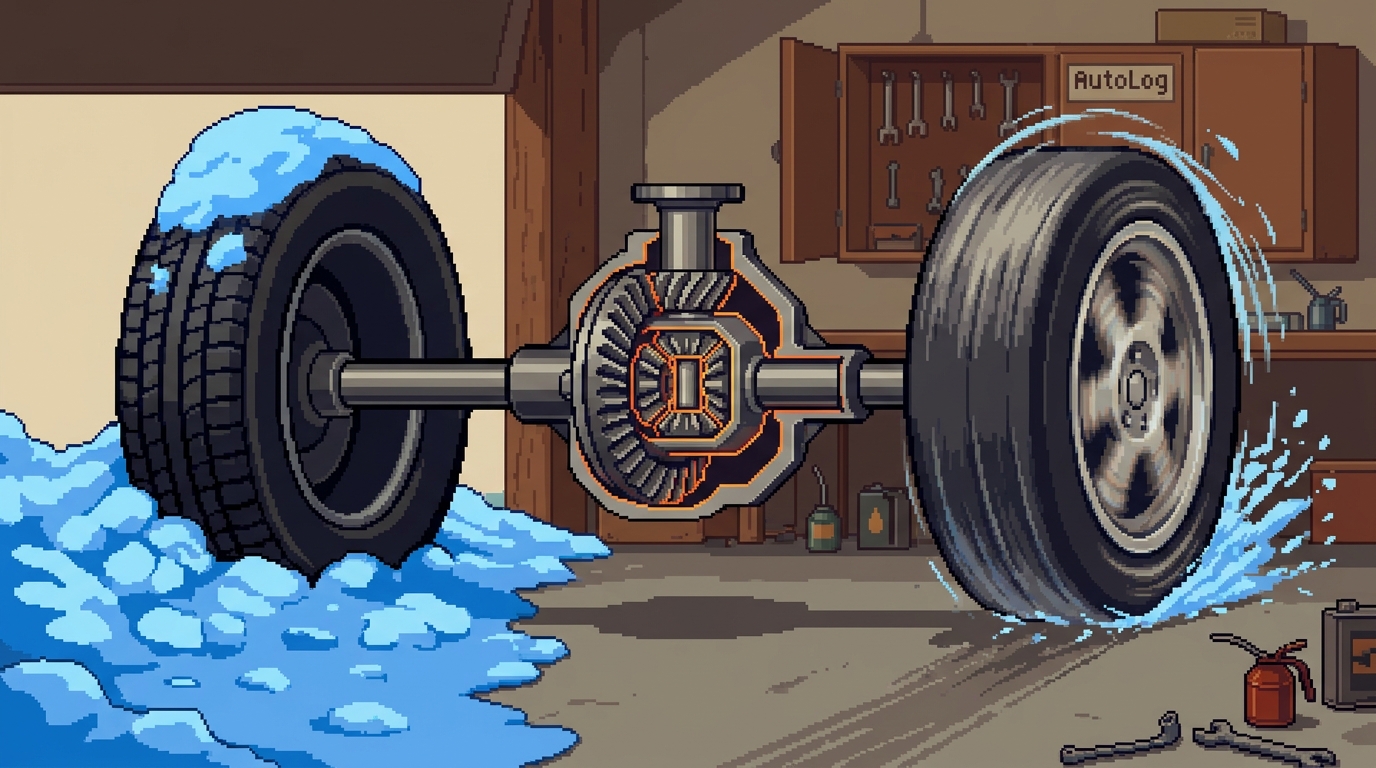
When one tire is held completely still by deep snow or ice, the open differential sends 100% of the rotational energy to the slipping wheel at exactly twice the indicated speedometer reading.
When one wheel gets trapped in deep snow or wedged against a curb, its rotational speed drops to zero.
Because the differential's carrier is still spinning from the engine's power, all that rotational energy must go somewhere. It gets multiplied and dumped directly into the unweighted, spinning wheel.
The math is unforgiving:
- Speedometer reads 30 mph: The stuck wheel is at 0 mph; the spinning wheel is spinning at 60 mph (96 km/h).
- Speedometer reads 50 mph: The stuck wheel is at 0 mph; the spinning wheel is spinning at 100 mph (160 km/h).
- Speedometer reads 70 mph: The stuck wheel is at 0 mph; the spinning wheel is spinning at 140 mph (225 km/h).
Because automotive speed sensors typically measure transmission output or average wheel speeds, drivers sitting comfortably in the cabin have no idea that the tire spinning outside in the snow is turning at triple-digit autobahn velocities.
Radial Expansion: Why Winter Tires Tear Apart
Automotive tires are flexible structures made of rubber compounds, polyester carcass cords, and woven steel belts. They are engineered to operate within strict centrifugal limits.
When a tire spins at 100 to 140 mph, centrifugal force pulls the tread outward away from the wheel rim. This phenomenon is known as radial expansion.
At normal highway cruising speeds, the weight of the vehicle and direct road contact help stabilize the tire footprint. But when a tire is floating freely in cold air and powder snow, there is no pavement pressure to restrain the tread.
The outer diameter of the tire physically stretches and balloons outward.
Winter tires and snow tires are especially vulnerable here. They use softer silica rubber compounds and deep, aggressive sipes designed for sub-zero flexibility, not high-speed centrifugal stress.
As the tire stretches beyond its engineering limits:
- Internal Cord Separation: The inner polyester and steel belts begin to delaminate from the rubber matrix under tension.
- Tread Delamination: The centrifugal force overpowers the adhesive bonds between the tread layer and the carcass.
- Catastrophic Rupture: The tire bursts like an over-inflated balloon, releasing explosive energy.
When a tire explodes under high rotational speed, it doesn't just go flat. The flying steel belts and shredded rubber act like high-velocity shrapnel.
They can obliterate plastic fender liners, rip quarter panels off the unibody, sever brake lines, and bend suspension arms—easily causing $2,000 to $4,000 in structural damage in a split second.
The Differential Meltdown: Frying the Cross Pin
Tires aren't the only components under fatal stress during wheelspin. Deep inside the drive axle, your differential is cooking itself alive.
Under normal driving conditions, the differential's small spider gears and pinion shaft (cross pin) only rotate a few turns relative to each other when rounding corners. Because their usage is normally low-speed and intermittent, these gears do not sit on roller bearings.
They ride directly on a steel shaft, relying entirely on a thin hydrodynamic film of differential gear oil for lubrication.
When you floor the accelerator in a snowbank and let one wheel spin furiously for thirty seconds, those spider gears rotate on the cross pin at thousands of RPM.
The severe rotational friction quickly generates immense heat:
- Oil Film Breakdown: Within seconds, localized friction boils the gear oil away from the pin surface.
- Metal-on-Metal Galling: Bare steel rubs against bare steel under extreme pressure, micro-welding the pin to the spider gear bore.
- Cross Pin Shear: Once the gear seizes onto the pin, the rotational force snaps the cross pin in half.
- Case Destruction: The broken pin segments get caught in the rotating ring and pinion gears, violently cracking open the cast iron or aluminum differential housing and dumping gear oil into the snow.
Replacing an entire rear differential assembly or transaxle after a snowbank meltdown routinely costs between $1,500 and $3,500.
The Polished Ice Trap: Why Heat Doesn't Save You
The persistent urban myth is that spinning tires will generate enough thermal friction to burn through ice and reach solid pavement.
Physics proves the exact opposite.
Snow and ice have a high latent heat of fusion. When rubber spins rapidly against snow, the friction melts a paper-thin microscopic layer of water.
In ambient sub-freezing temperatures—especially on packed snow—that thin layer of liquid water acts as a high-speed hydrodynamic lubricant. Friction drops to near zero.
Then, as soon as you lift off the throttle for a moment, that warm water film immediately freezes solid against the cold sub-base.
Instead of finding dry pavement, furious spinning carves smooth, polished hollows directly underneath your drive tires. Mechanics call this "glazing the cradle." Once your tires are sitting in polished ice cups, your chances of driving out under vehicle power alone drop to practically zero.
How to Actually Get Out: The Safe Recovery Blueprint
If your vehicle slides into a drift or spins on a packed incline this winter, step away from the accelerator pedal. Getting unstuck requires patience, technique, and traction aids—not horsepower.
1. The 15 mph Wheel Speed Rule
Never allow your speedometer to exceed 15 mph (25 km/h) while attempting to move.
Gentle throttle input allows tire sipes to mechanically interlock with snow crystals. If the wheels begin to slip with zero forward movement, let off the gas immediately. Spinning longer than three to five seconds will only glaze the surface.
2. Know When to Toggle Traction Control (TCS)
Modern traction control systems automatically cut engine power or pulse the ABS brakes when they detect wheel slip.
On loose snow or deep slush, this can bog the car down completely and prevent forward momentum.
Before trying to move, press the Traction Control button on your dashboard to turn off engine power cuts. This allows the tires to turn smoothly at low RPM. Remember to turn TCS back on as soon as you return to plowed roads.
3. Clear the Undercarriage First
Before attempting to drive, step out and inspect the vehicle.
If the belly pan or differential housing is resting on a high-centered mound of hard-packed snow, the drive wheels carry very little vehicle weight. No amount of throttle will move a car whose weight is supported by its chassis floor.
Use a folding snow shovel or your boots to clear snow away from directly in front of all four tires and carve out the snow packed beneath the undercarriage.
4. The Gentle Rocking Technique
Rocking the vehicle uses momentum and suspension rebound to carry you out of a snow pocket:
- Straighten the steering wheel so the front tires don't act like snowplow blades.
- Shift into Drive (or First gear) and tap the accelerator gently to roll forward a few inches.
- At the peak of forward movement, firmly press the brake pedal to hold that ground.
- Shift into Reverse, release the brake, and tap the throttle to roll backward a few inches.
- Apply the brake at the crest of the backward roll, shift to Drive, and repeat in a smooth, rhythmic motion.
Important: Always bring the wheels to a complete stop with the foot brake before shifting between Drive and Reverse. Shifting gears while the wheels are still rotating will destroy automatic transmission clutches and CV joints.
5. Create Instant Mechanical Traction
If rocking doesn't free the car within a couple of cycles, give the tires something abrasive to bite:
- Traction Boards: Purpose-built recovery tracks (such as Maxtrax or compact folding boards) wedge under the tires and provide instant grip.
- Floor Mats (Rubber Side Down): In a pinch, place your heavy-duty rubber floor mats upside down (carpet side against the snow, rubber ribs against the tire tread) directly in front of the drive wheels.
- Kitty Litter or Coarse Sand: Keep a small bag of non-clumping clay cat litter or coarse sandbox sand in your trunk. Pouring a generous amount directly ahead of the drive tires creates coarse friction on polished ice.
Safety Rule: Never Stand Near a Spinning Wheel
If someone stops to help push your vehicle out of a drift, establish one non-negotiable safety rule before touching the car:
Never let anyone stand directly behind, beside, or in line with a spinning tire.
If a tire fails under rotational stress, shredded steel belts and heavy rubber fragments explode outward with the force of an industrial shrapnel grenade. Furthermore, tires spinning on loose gravel or ice can eject rocks, ice chunks, or floor mats backward at lethal speeds.
Helpers should only push from the corners or sides of the vehicle, well clear of the rotational arc of any drive wheel.
Taking twenty minutes before the first winter blizzard to stock a compact folding shovel, a pair of warm work gloves, and a bag of coarse traction sand in your trunk can save you hours in the freezing cold—and prevent thousands of dollars in blown tires and shattered differentials.
While you are preparing your vehicle for sub-zero weather, keeping track of seasonal tire rotations, snow tire swap dates, and differential fluid change intervals in a clean, free digital tool like AutoLog makes winter maintenance straightforward. When severe weather hits, knowing your drivetrain and tires are properly serviced gives you genuine confidence on the road.
Disclaimer: This article is intended strictly for educational and informational purposes. Attempting to recover a stuck motor vehicle involves inherent physical dangers, including mechanical failure, structural vehicle damage, and personal injury from rotating components or shifting vehicles. Never exceed manufacturer recommendations for wheel speed during vehicle recovery, and never allow individuals to position themselves near spinning tires. If a vehicle cannot be safely freed with gentle techniques, contact a licensed professional towing and recovery service. Sukiwave and AutoLog assume no liability for equipment damage, collisions, or personal injury resulting from vehicle recovery actions taken based on this editorial content.