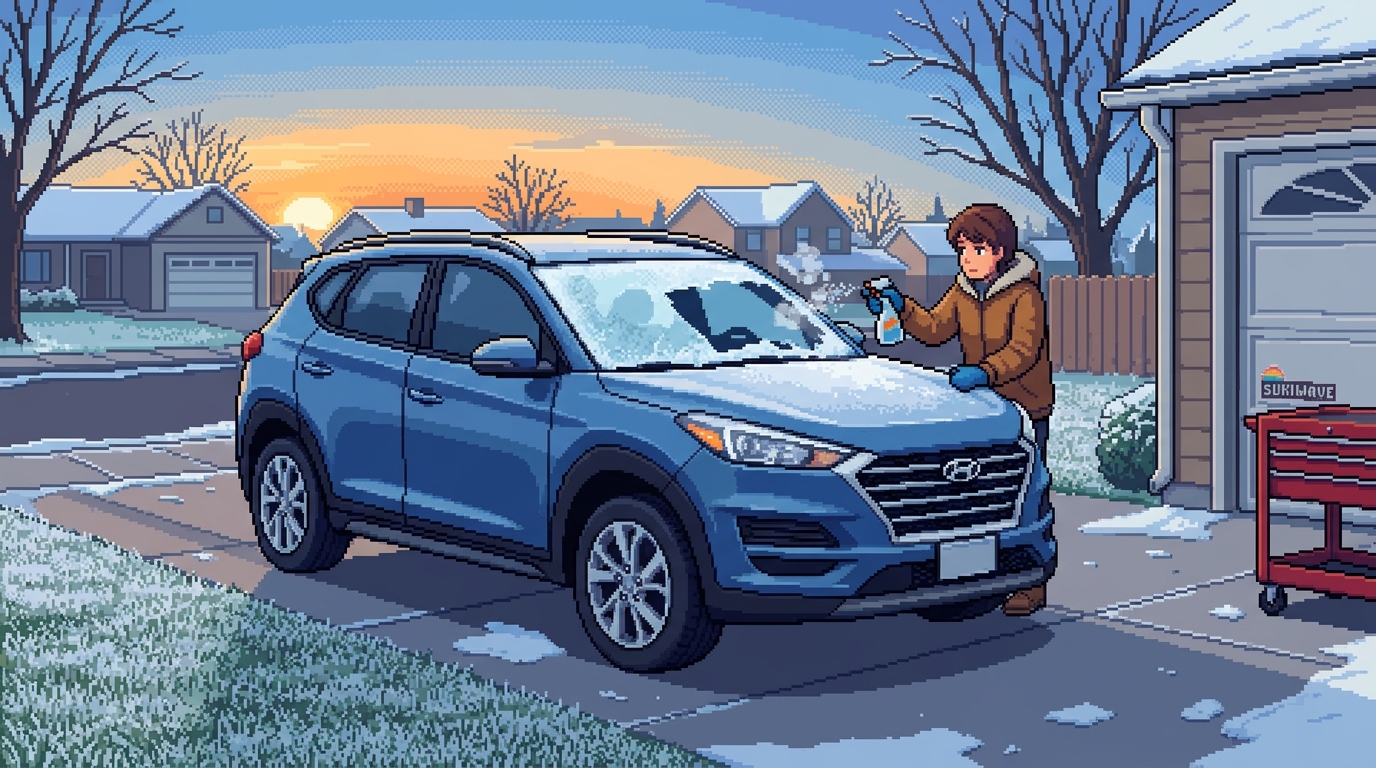
It is 7:12 AM on a brutal mid-November morning.
You are already eight minutes late for work. Your breath is coming out in thick white clouds, and you're shivering in your driveway holding a lukewarm paper cup of Tim Hortons coffee between your knees.
You walk up to your car, and your heart sinks. Your windshield is completely buried under a stubborn, quarter-inch crust of opaque white frost.
You check your glove box for that plastic ice scraper. Gone. (You probably tossed it into a random tote bin back in April). You try scraping the driver’s side with an old Starbucks gift card, but after forty seconds of frantic rubbing, all you have to show for it is frozen, aching fingertips and a tiny three-inch peephole.
Then, your eyes wander toward the kitchen window.
The tea kettle.
It sounds like pure, unadulterated genius. Why stand out here freezing your hands off when you have near-boiling water inside? You can just pour it across the glass, watch the ice melt away like magic, jump in the warm cabin, and drive away smiling.
Look. I get it. I really do.
About ten years ago, when I was twenty-two and running late for a job interview in a sub-zero Minnesota freeze, I did the exact same thing. I filled a glass measuring pitcher with scalding tap water, ran outside, and dumped it across the windshield of my dad’s old Honda Civic.
For about two seconds, it looked glorious. The sheet of ice vanished into pure, running water.
And then, a sickening sound echoed through the quiet neighborhood.
SNAP.
It wasn't a dull thud. It sounded like a high-powered rifle shot right in my face. A jagged, spiderweb fracture ripped from the wiper cowl straight up to the roofline, right in my direct line of sight. My stomach dropped through the icy driveway. I just stood there, holding an empty kitchen pitcher in my gloves, praying no neighbors were looking out their windows.
Put the kettle down. Seriously.
Here is what is actually going on with your car, why modern tech turns this into a four-figure nightmare, and the cheap little trick that actually works.
Key Takeaways (Quick Summary):
* The glass is way thinner than you think: Your windshield isn't a thick, solid slab. It’s two paper-thin layers of glass gluing a sheet of plastic together. Boiling water makes the outside expand like crazy while the inside stays frozen stiff, tearing itself apart.
* That tiny rock chip is a ticking bomb: Even a microscopic pit from a highway dump truck acts like the little tear-notch on a potato chip bag. Once thermal stress hits that notch, the crack rips clean across.
* Warm water is a sneaky trap: Even lukewarm sink water shocks freezing glass. Worse, it runs straight down into your wipers and cowl, flash-freezing into block ice within ninety seconds.
* The $1,400 surprise on modern cars: If your car has front cameras for automatic braking or lane centering, replacing cracked glass means paying hundreds extra for laser calibration targets.
* The $2 spray bottle solution: Keep a spray bottle of rubbing alcohol mixed with a little water and a drop of dish soap inside the house. It melts frost into soft slush in twenty seconds with zero thermal shock.
What Actually Happens Behind That Thin Sheet of Glass
Most people picture automotive windshields like heavy commercial storefront windows. In reality, they are shockingly delicate.
Take a close look at the edge of your glass sometime. Your front windshield is basically a high-tech glass sandwich. You have an outer sheet of glass barely two millimeters thick (about the thickness of two dimes stacked together), a flexible plastic film glued in the middle to catch flying shards, and an inner sheet of glass on the cabin side.
Glass is naturally terrible at moving heat around. If you touch one side with a blowtorch, the other side takes its sweet time getting warm.
So imagine what happens on a sub-zero morning:
That glass has been soaking in 10-degree air all night long. When you dump a steaming pot of 160-degree water onto it, the outer sheet of glass tries to violently expand in a fraction of a second. But because heat travels through glass so slowly, the inside sheet—and that cold plastic core—stays frozen solid and completely unyielding.
The outside is fighting the inside. Glass can handle being pressed or squeezed all day long, but the moment you try to pull it apart with sudden thermal tension, it has almost zero give.
The Potato Chip Bag Effect
Every winter, somebody always chimes in: "Well, I saw a guy on TikTok do this with warm water in a Ziploc bag and his glass was totally fine!"
Sure. And that guy was probably driving a showroom-fresh car with zero miles on it.
If you’ve driven on a highway anytime in the last six months, you have stone chips. You might not even notice them unless the afternoon sun hits the glass at just the right angle. Maybe a gravel truck spat a tiny fleck of silica at you three weeks ago, leaving a pit no bigger than the tip of a sewing needle.
On a normal day, that tiny pit does nothing. But the second that wave of boiling water forces the glass to expand, all of that pulling stress rushes straight into the bottom of that pit.
It works exactly like the little pre-cut tear notch on the top of a potato chip bag. You can pull on the plastic bag with both hands and it won't budge. But grab that little notch and pull? It tears wide open with zero effort.
That microscopic stone chip is your tear notch. The second the hot water hits it, the fracture rips across the glass faster than you can blink.
Why "Warm" Water Is Sneakily Worse (And How It Re-Freezes)
Whenever I tell people never to use boiling water, the immediate response is always: "Okay, but what if I just use warm water from the bathroom faucet?"
Honestly, lukewarm water causes almost as many tow truck calls as boiling water, just for a slightly sneakier reason.
First off, the temperature shock is still there. If it’s 5°F outside, even room-temperature 60-degree tap water hits that glass with a sudden 55-degree temperature jump. If your glass is already stressed from chassis flex or a tiny rock strike, that is more than enough to pull the trigger.
But here is the real disaster: water has zero antifreeze properties.
When you pour a thin sheet of lukewarm water across freezing sheet metal and glass, it loses its heat almost instantly. The water rolls off your windshield, drains down past your wipers, and pools right inside the plastic cowl tray where your wiper transmission linkages and washer fluid nozzles live.
By the time you scrape the snow off your rear window, get inside, and turn the key, that pooled water has flash-frozen into rock-solid block ice.
Now your wiper blades are literally mortared to the cowl. If you bump the wiper stalk out of habit, you will hear a sickening crunch as the wiper motor strips the mechanical teeth clean off the drive linkage—or blows the wiper fuse completely, leaving you with zero wipers in the middle of a snowstorm.
The $1,400 Tech Tax Nobody Warns You About
Back when I shattered my dad's Civic in 2014, it was an embarrassing headache, but it wasn't a life-altering expense. I called a local mobile glass van, handed the guy $180 cash in the driveway, and he glued a new piece of glass in place while I ate lunch.
If you drive a car built in the last five or six years, try calling a glass shop today. You are in for a massive shock.
Look up behind your rearview mirror. You'll see a big black plastic housing mounted flush against the top of the windshield. Inside that housing sits the forward-facing optical eye of your car's brain: the camera that runs your Automatic Emergency Braking, Forward Collision Warning, and Lane Keep Assist.
When a technician replaces your windshield today, putting the glass on is only half the job.
Because that camera is looking through the curvature of the glass, the car's computer has to be completely recalibrated:
* Static Calibration: The shop has to set up laser-measured geometric target boards in a massive, perfectly level bay to teach the camera exactly where the center of the lane is.
* Dynamic Calibration: A tech has to take your car out on the highway and drive for twenty or thirty miles while connected to a scan tool until the sensors sync with real-world road markings.
That calibration process alone regularly costs between $300 and $600 in specialized labor. Add in the cost of high-grade acoustic glass, and a routine windshield swap easily totals $1,100 to $1,600.
Suddenly, trying to save three minutes before work costs you your entire comprehensive insurance deductible—or a massive out-of-pocket bill right before the holidays.
The $2 Spray Bottle Trick (The Only Fix That Actually Works)
You don’t have to freeze your knuckles off rubbing a plastic card against sheet ice, and you definitely don’t have to gamble your windshield.
Here is the exact setup I keep on my shoe rack every winter. It costs about two bucks to make, takes thirty seconds, and works every single time.
The Home Pharmacy Mix
Grab an empty plastic spray bottle from under the sink and head to the medicine cabinet:
* Fill about two-thirds of the bottle with standard 70% or 91% Isopropyl Alcohol (basic rubbing alcohol from the drugstore).
* Fill the remaining third with regular tap water.
* Add one single drop of liquid dish soap.
Give it a gentle shake.
Why does this work so ridiculously well? Pure rubbing alcohol doesn’t freeze until it hits -128°F (-89°C). When you mix it with water in this ratio, the freezing point stays well below -20°F (-29°C).
The drop of dish soap is the secret weapon: it acts as a surfactant, breaking the surface tension so the alcohol doesn’t just bead up and roll off. It immediately seeps into every microscopic crack between the ice crystals.
When you walk outside and mist this over frosted glass, the ice chemically turns into soft, slushy mush right before your eyes. You don't have to scrape hard—you just swipe the slush away with your rubber squeegee or soft scraper.
And because alcohol doesn't generate heat, there is zero temperature shock. Your glass doesn't even know what happened.
Just one rule: Keep the spray bottle inside the warm house overnight, not in your trunk where the plastic bottle gets ice-cold.
The Real Way to Use Your Cabin Heater
A lot of people jump in the car, twist the heater dial all the way to red, crank the blower fan to hurricane speed, and wonder why nothing happens for ten minutes.
If you want to clear the glass from the inside, work with physics instead of against it:
First, start the car and set the temperature to warm, but leave the fan on low. Your heater borrows warmth from engine coolant. When the engine is cold, blasting the fan on high just pulls whatever tiny bit of heat exists right out of the system, making the engine take twice as long to warm up. Let the temperature needle climb before turning the fan up.
Second, push the A/C button. Yes, even when it's freezing. The air conditioning compressor isn't just for cold air; it’s an active dehumidifier. It wrings water vapor out of the air so it doesn't fog up the inside of your glass.
Third, make sure Air Recirculation is OFF. When you sit in a freezing car, your warm breath is basically 100% humidity. If you leave recirculation on, you are blowing your own moist breath directly onto freezing glass, where it immediately turns into stubborn interior frost. Pulling in cold, dry winter air from outside dries the cabin out twice as fast.
Treat Your Wiper Blades Like Gold
One final plea from someone who has ruined far too many winter mornings: never flip that wiper switch when the blades are frozen to the glass.
Wiper blades glide smoothly because they have a microscopic layer of powdered graphite on the rubber edge. If that blade is frozen to textured ice and you yank it with the wiper motor, it tears that graphite coating right off. From that morning forward, your wipers will screech and leave massive blurry streaks directly across your view.
Before you get in the car, just reach out with your glove and give both wiper blades a gentle tug to make sure they are completely free from the glass.
A Quick Garage Habit Before Winter Really Hits
At the end of the day, winter driving is all about getting ahead of the cold instead of panicking on a frosty Tuesday morning.
Making sure you have your winter wiper blades installed, keeping your washer fluid filled with fluid rated for -40, and having that alcohol spray bottle ready to go makes the difference between a smooth commute and a ruined morning.
If you are like me and constantly forget when you last replaced your wipers or what fluid is currently in your reservoir, tools like AutoLog make it effortless. You can snap a photo of your parts receipts with Gemini AI, log your seasonal prep in seconds, and keep a clean digital record of your car’s maintenance history right on your phone.
When that first big blizzard rolls in and your car is ready to roll while your neighbors are chipping away at their windshields, you’ll be glad you took two minutes to do it right.
Disclaimer: This article is intended strictly for educational and informational purposes. Automotive glass composition, vehicle defrosting systems, and ADAS sensor calibrations vary across vehicle manufacturers and model years. Never pour boiling or hot liquids onto automotive glass. Always consult your vehicle's owner's manual for recommended defrosting procedures and maintenance specifications. Sukiwave and AutoLog assume no liability for cracked glass, ADAS sensor misalignment, or mechanical damages resulting from the use of de-icing techniques or chemicals.