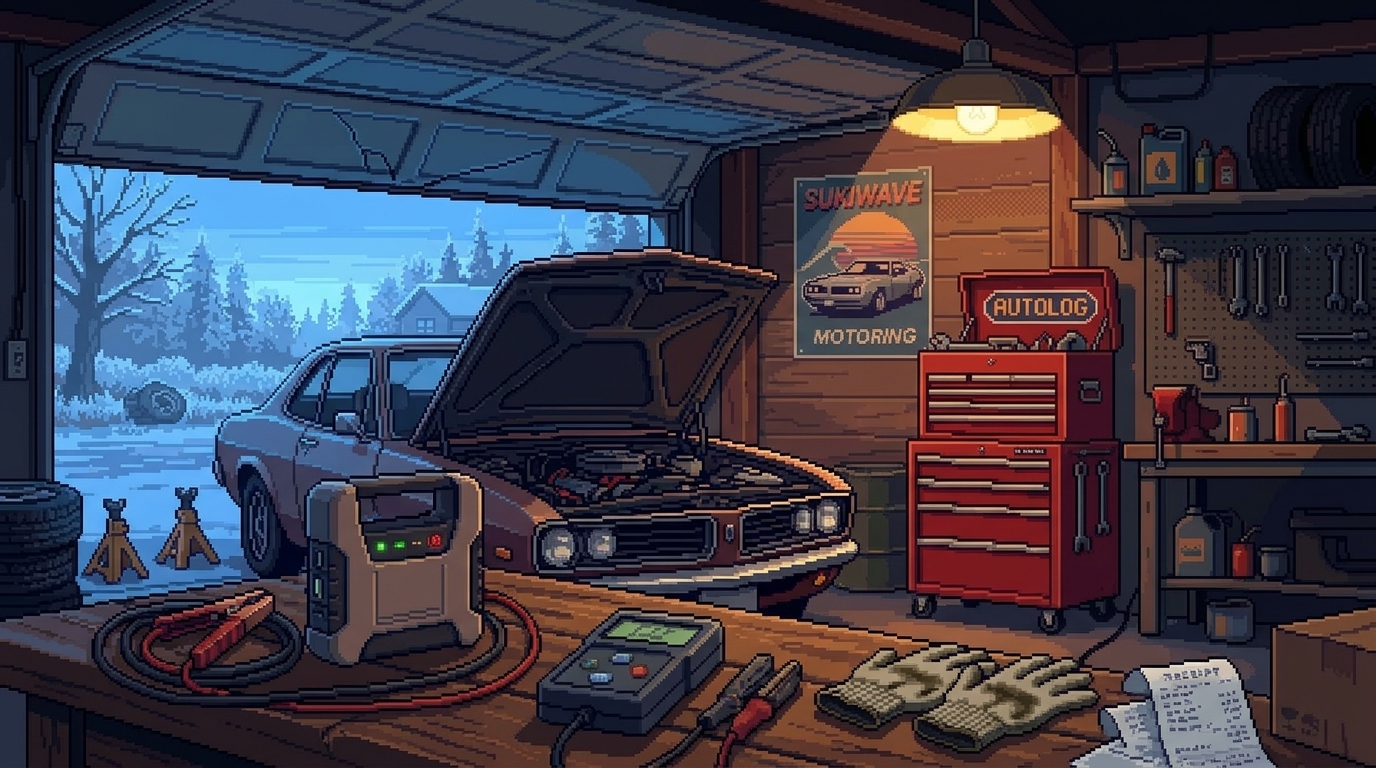
You walk out to your driveway on the first crisp, freezing morning of autumn. Your breath fogs in the 32°F (0°C) air. You slide into the driver’s seat, press the start button, and instead of the reassuring roar of your engine, all you hear is a frantic, hollow click-click-click.
The dashboard lights flicker like a dying candle, and the infotainment screen goes pitch black.
Like millions of drivers across North America, you probably have a sleek, compact lithium jump starter tucked away in your glovebox or trunk organizer. You bought it for peace of mind. You know the theory: red to positive, black to negative.
Except on a modern vehicle, that "common sense" move could turn a simple $150 dead battery into a catastrophic $2,500 repair bill with a fried Engine Control Unit (ECU).
Key Takeaways (Quick Summary):
* The Cold Snap Myth: Winter cold doesn't kill your battery; brutal summer heat cooked its internal lead plates, and the first autumn freeze simply exposed the fatal weakness.
* The $2,000 Surge Risk: Modern vehicles carry up to 50 interconnected microprocessors; connecting jump cables improperly creates inductive voltage spikes that can instantly destroy sensitive modules and digital instrument clusters.
* The Grounding Rule: Never connect the negative clamp directly to the negative battery terminal on a modern car—you risk igniting hydrogen gas and bypassing the vehicle's onboard Battery Management System (BMS).
* The Roadside Advantage: In regions like British Columbia (BCAA) or across North America (CAA/AAA), calling professional roadside assistance pays for your annual membership in a single cold-weather visit with on-the-spot battery replacement and real warranty coverage.
* The Smart Paper Trail: Whether you replace your battery in your garage or let a roadside technician handle it, logging the test results and warranty receipts in AutoLog protects your vehicle’s electrical provenance for future buyers.
The Cold Snap Ambush: Batteries Don't Die in Winter, They Die in Summer
There is a universal misconception in cold climates: people believe freezing winter temperatures "kill" car batteries.
The electrochemistry tells a very different story.
During the blistering heat of July and August, under-hood temperatures frequently exceed 140°F to 170°F (60°C to 75°C). That intense thermal environment accelerates internal grid corrosion and causes the liquid electrolyte inside conventional flooded batteries to slowly evaporate. The chemical structure degrades irreversibly while you are cruising with the air conditioning blasting.
Then comes late September and October. When the thermometer plummets to freezing:
1. Chemical sluggishness: A battery’s chemical reaction rate drops by roughly 30% to 50% at 32°F (0°C).
2. Mechanical resistance: Your engine oil thickens from a free-flowing liquid into cold syrup, requiring up to twice as much rotational power (amperage) from the starter motor to turn the crankshaft.
A heat-damaged battery that had just enough juice to start a warm engine in August simply cannot muster the Cold Cranking Amps (CCA) required on a frosty October morning. The cold didn't commit the murder; it merely discovered the body.
The $2,000 Spark: How Modern Electronics Changed Jump-Starting Forever
In 1985, jump-starting a vehicle was caveman simple: slap two heavy copper jumper cables between two idling trucks, let sparks fly, and rev the engine. If the voltage spiked to 16 volts for a second, a carbureted cast-iron V8 couldn't care less.
Try that on a modern daily driver, and you are playing Russian roulette with a digital motherboard.
Today's vehicles are rolling data centers. High-speed Controller Area Network (CAN-bus) lines link your Engine Control Unit, Transmission Control Module, Body Control Module, radar cruise sensors, and touchscreen interfaces. These solid-state microcontrollers operate on sensitive 5-volt or 3.3-volt logic rails.
When a jump starter is connected or disconnected while current is flowing, it can generate an inductive voltage spike—a sudden electrical surge that can spike past 18 to 24 volts in milliseconds. That spike is more than enough to punch through delicate silicone semiconductors.
Worse yet, nearly all modern vehicles (particularly European and modern Japanese models like Honda, Toyota, and Subaru) feature an intelligent Battery Current Sensor (a micro-shunt) clamped directly to the negative battery terminal. If you clamp your jumper lead directly onto the negative battery post, you bypass this sensor. The sudden surge of unregulated current can instantly cook the sensor module or scramble the computer's charging calibration tables.
Anatomy of the Rescue: The Strict 5-Step Protocol for Portable Lithium Jump Starters
Portable lithium jump packs (such as NOCO Boost or similar compact units) are engineering marvels. They store immense energy in a package the size of a paperback novel. However, you must execute the connection ritual with surgical precision:
- Step 1: All Accessories Dead Off. Turn off headlights, seat heaters, climate blowers, and infotainment screens. Unplug all USB phone chargers. You want zero parasitic electrical draw.
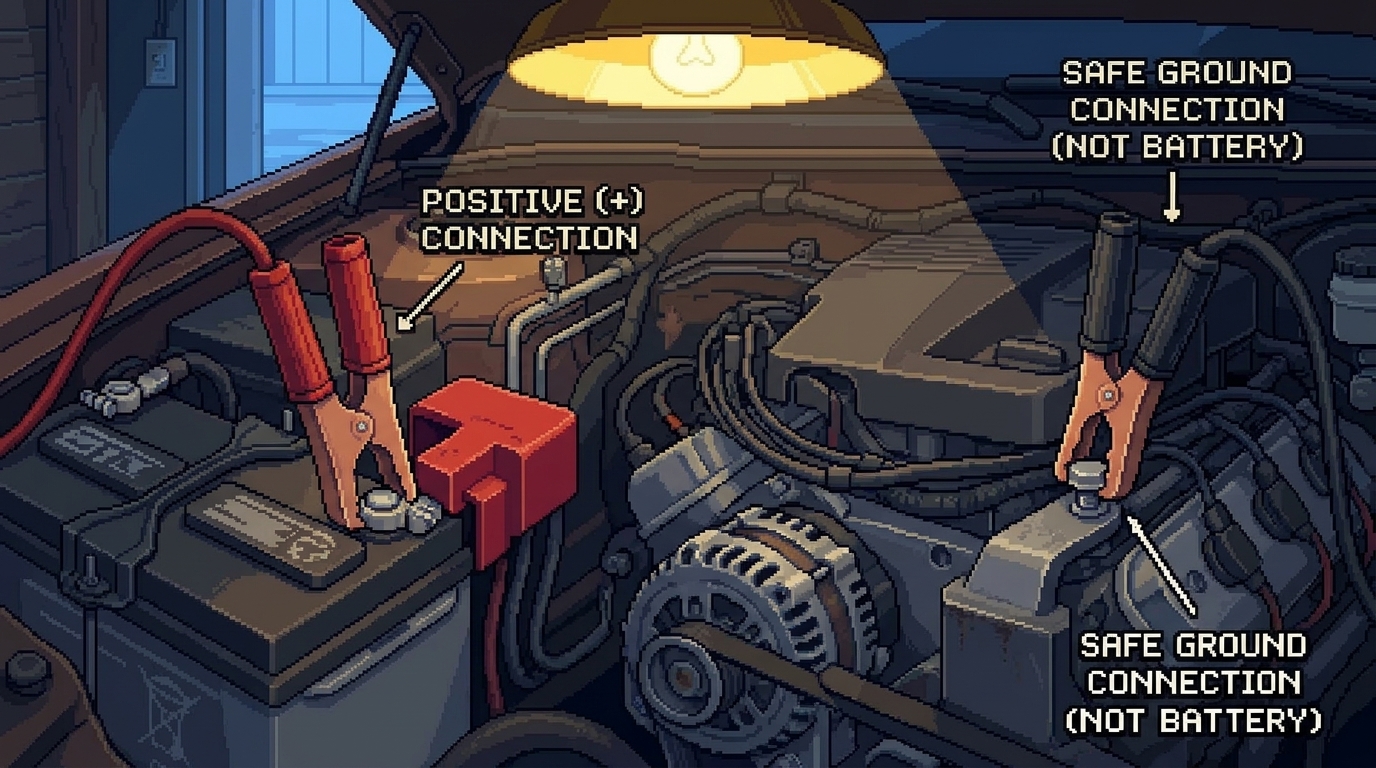
- Step 2: Connect the RED (Positive) Clamp First. Fasten the red clamp firmly to the clean, positive (+) battery terminal (usually protected by a red plastic cover). Ensure a solid, bite-through connection with no loose wiggling.
- Step 3: Connect the BLACK (Negative) Clamp to Ground. Do not attach this clamp to the negative battery post. Instead, find a bare, unpainted metal bolt, an unpainted engine lifting bracket, or a dedicated chassis ground post away from the battery.
- Step 4: Power On the Unit and Crank. Turn on the jump pack power switch. Verify the indicator confirms a safe connection (solid green / ready). Step into the vehicle and crank the engine for no longer than 3 to 5 seconds. If it does not start immediately, wait 60 seconds before trying again to avoid overheating the lithium cells.
- Step 5: Disconnect Immediately Within 30 Seconds. Once the engine is idling smoothly, disconnect the jump starter immediately (starting with the black negative ground clamp first, then the red positive clamp). Leaving a lithium pack connected to a running vehicle allows the alternator to back-feed high charging amperage into the pack, which can damage the portable unit or trigger thermal runaway.
Where Exactly is "Ground"? (Why You Must Unlearn the Old Way)
Most of us learned to jump-start cars from our parents or driving instructors decades ago: "Red to red, black to black."
On older vehicles without microprocessors, connecting directly to the battery's negative terminal worked. But on modern daily drivers, clamping your negative jumper cable directly to the battery terminal does two dangerous things:
1. It bypasses the Battery Management System (BMS): Modern vehicles have a delicate current-sensing shunt attached right to the negative post. Bypassing it sends unregulated amperage through the vehicle's electronic network.
2. It risks a hydrogen gas ignition: The final connection always produces a microscopic spark. Lead-acid batteries naturally vent flammable hydrogen gas during discharge. Making that sparking connection inches away from the battery vent can trigger an explosion.
So, where should you actually clamp that black cable?
Look for an unpainted steel bolt head on the engine block, a heavy metal lifting loop (engine hoist bracket), or a chassis ground post specifically stamped with a minus (-) sign near the strut tower. Never clamp onto painted metal, plastic covers, fuel lines, or rotating pulleys.
The Smarter Play: Why Roadside Services (Like BCAA) Are Worth Every Dollar
While having a portable jump starter in your trunk is a phenomenal backup for emergencies in remote locations, attempting DIY electrical rescues in your driveway on a freezing workday morning isn't always the smartest play.
In British Columbia, Canada, the BCAA (British Columbia Automobile Association)—and its counterparts like CAA across Canada and AAA in the United States—operates dedicated battery mobile service fleets.
If your vehicle won't crank, calling BCAA or your local auto club is often the most cost-effective decision you can make:
- Professional Conductance Diagnostics: A roadside technician doesn't just guess; they hook up an advanced conductance diagnostic tester that evaluates your battery’s internal resistance, true Cold Cranking Amps (CCA), and alternator charging diode ripple within two minutes.
- On-the-Spot Mobile Replacement: If the battery has suffered irreversible cell degradation, they carry genuine-spec, high-grade replacements directly in the service van. They swap the unit on your driveway, clean the terminal corrosion, and properly calibrate the vehicle’s charging system.
- Unbeatable Warranty & Peace of Mind: Quality roadside club batteries typically come with a multi-year nationwide free replacement warranty. If it drops a cell two winters from now in the middle of nowhere, another truck comes to you at zero labor cost.
- The Math Speaks for Itself: An annual basic or plus membership ($80 to $140 CAD/USD) costs less than half of a single emergency commercial tow or a one-hour dealership diagnostic fee ($180–$250/hr). A single rescued morning, free lockout assistance, or mobile battery swap instantly recoups your annual dues for the next two years.
Knowing when to deploy your portable pack and when to let a professional mobile service handle the heavy lifting is the hallmark of a mature, practical car owner.
Don't Guess the Health: Multimeter vs. True CCA Testers
Many DIYers pull out a cheap digital multimeter, touch the probes to the battery, read 12.5V, and declare: "The battery is totally fine, it must be the starter or fuel pump!"
This is the classic Surface Charge Illusion.
A dying battery with sulfated lead plates can easily hold 12.6 volts with zero load. But the moment you demand 400 amps to spin a freezing four-cylinder or V6 engine, the internal resistance causes the voltage to instantly collapse off a cliff to 6 volts.
If your battery is more than 3 to 4 years old, invest $35 in an entry-level digital battery conductance tester (brands like Topdon or Ancel). These handheld digital tools test the battery under simulated dynamic load and report the exact remaining Cold Cranking Amps versus the factory rating printed on the label.
If your 650 CCA battery is only producing 310 CCA on a chilly autumn afternoon, do not wait for the first sub-zero snowstorm to strand you in an office parking lot. Replace it proactively on your own schedule.
Bridge the Carfax Gap: Keeping Your Electrical Paper Trail Clean
Modern used-car buyers are terrified of electrical gremlins. In the era of touchscreens, complex wiring harnesses, and hybrid powertrains, a flickering dashboard or unexplained no-start history can instantly kill a private sale.
Dealership service records and Carfax often omit battery replacements performed by roadside services like BCAA or DIY installs in home garages.
When you replace your battery:
1. Log the Precise Battery Specs: Record the exact group size (e.g., Group 35, 24F, H6/Group 48), chemistry (Flooded vs. AGM), and Cold Cranking Amps (CCA).
2. Snap the Receipt & Warranty Card: BCAA, AAA, or auto parts store receipts printed on thermal paper fade into unreadable blank slips inside your glove compartment. Take a high-resolution photo of the invoice showing the installation date and warranty terms.
3. Note the BMS Reset: If your modern vehicle required a Battery Management System registration or coding scan, document that it was completed to prove the alternator didn't overcharge the new unit.
When it comes time to hand the keys to the next owner, you won't be fumbling through a stack of yellowed papers or trying to explain why the car had a dead battery last November. You simply provide a clean, transparent digital record proving that the vehicle’s electrical heart has been professionally maintained and protected.
Disclaimer: Automotive batteries contain sulfuric acid and generate explosive hydrogen gas during operation and charging. Jump-starting improperly can cause severe personal injury, chemical burns, electrical shock, or permanent damage to vehicle electronics. Always wear approved eye protection, avoid open flames, and consult your vehicle’s factory owner’s manual for specific jump-starting and grounding instructions before attempting any service.