Have you ever asked a dealership service advisor to change your transmission fluid, only to have them look at you like you just asked for an oil change on a toaster?
"Oh, that’s a sealed unit, sir. It has lifetime fluid."
Whenever a service writer says "lifetime," what they really mean is: "It will last just long enough to roll past your warranty, right before it explodes into a $6,000 paperweight."
TL;DR (The Quick Wrench):
- The "Lifetime" Scam: Automakers define "lifetime" as the powertrain warranty window—usually 5 years or 60,000 to 100,000 miles (100,000 to 160,000 km).
- The Financial Trap: Skipping fluid changes turns clean friction discs into metallic grit, guaranteeing a $5,000–$7,000 USD ($6,800–$9,500 CAD) transmission rebuild down the road.
- The Fix: Never use high-pressure power flushes on older cars. Perform a gentle gravity Drain & Fill every 30,000 to 60,000 miles (50,000 to 100,000 km) using exact OEM-spec fluid.
- Protect Your Resale: Automatic transmission failures terrify private used-car buyers. Logging your DIY services in AutoLog bridges the "Carfax Gap" and proves your gearbox is bulletproof.
The Big Myth: Industry / Dealer Reality
Let’s cut through the corporate marketing gloss: no liquid on planet Earth lubricates mechanical components indefinitely. Believing in "lifetime" transmission fluid is like believing the milk at the back of your fridge stays fresh as long as you don't open the carton.
So why do automakers plaster "Never Needs Replacement" in the owner's manual? Simple: it artificially lowers the vehicle’s advertised "Cost of Ownership" for the first few years. Fleet buyers and new-car shoppers love seeing zero scheduled transmission maintenance on the brochure.
The punchline? To the manufacturer, the vehicle's "life" officially ends the second your powertrain warranty expires at 60,000 miles (100,000 km). When your gearbox inevitably starts shuddering, slipping, and puking burnt friction material at 115,000 miles (185,000 km), the dealership doesn't shed a tear. Why would they? That’s an immediate $5,000 to $7,000 USD ($6,800 to $9,500 CAD) bill in their service bay to drop in a remanufactured unit. Their definition of "lifetime" just bought their service department a brand-new boat.
Anatomy of the Problem (How It Works & Why It Fails)
Automatic transmission fluid (ATF) is mechanical witchcraft. Unlike engine oil, which just lubricates and cleans, your ATF wears four hats simultaneously: it acts as a hydraulic fluid (transferring engine power through the torque converter to physically shift gears), a heat-dispersion coolant, a friction modifier for clutch packs, and a protective detergent.
Over time, two brutal enemies wage war inside your gearbox: heat and friction.
- Thermal Breakdown: Transmission fluid typically operates around 175°F to 200°F (80°C to 93°C). For every 20°F drop or spike above that range under heavy loads (towing, stop-and-go commuting, or mountain climbs), the life of the fluid cuts in half. The protective detergents cook off, and the liquid thins out.
- Clutch Contamination: Automatic gearboxes contain dozens of clutch plates lined with delicate friction material. As they engage, microscopic clutch fibers and metallic micro-shavings shed directly into the fluid.
Eventually, that lovely, sweet-smelling ruby-red liquid turns into a burnt brown slurry that smells like roasted battery acid. This sludge clogs the tiny passages in your valve body (the hydraulic "brain" maze of your transmission), sticking the solenoids and causing harsh gear shifts, slipping, and terminal failure.
The Safe & Smart Action Plan (How to Do It Right)
If you want your automatic transmission to hit 250,000+ miles (400,000+ km) without breaking a sweat, ignore the dealer's fairy tales and follow the real mechanic’s playbook.
The Golden Interval
Drain and replace your transmission fluid every 30,000 to 60,000 miles (50,000 to 100,000 km). If you tow trailers or deal with brutal city traffic, stick strictly to the 30k-mile (50k-km) mark.
The "Drain & Fill" vs. The "Power Flush" Death Trap
Here is where amateur mechanics get burned.
- The Dangerous Way (Power Flush Machine): Never hook an aging transmission (especially one past 100,000 miles / 160,000 km with unknown history) to a high-pressure commercial flush machine. These aggressive pumps blast loose sediment backwards through the valve body, dislodging settled clutch debris and jamming the electronic solenoids. It’s the automotive equivalent of a heart attack.
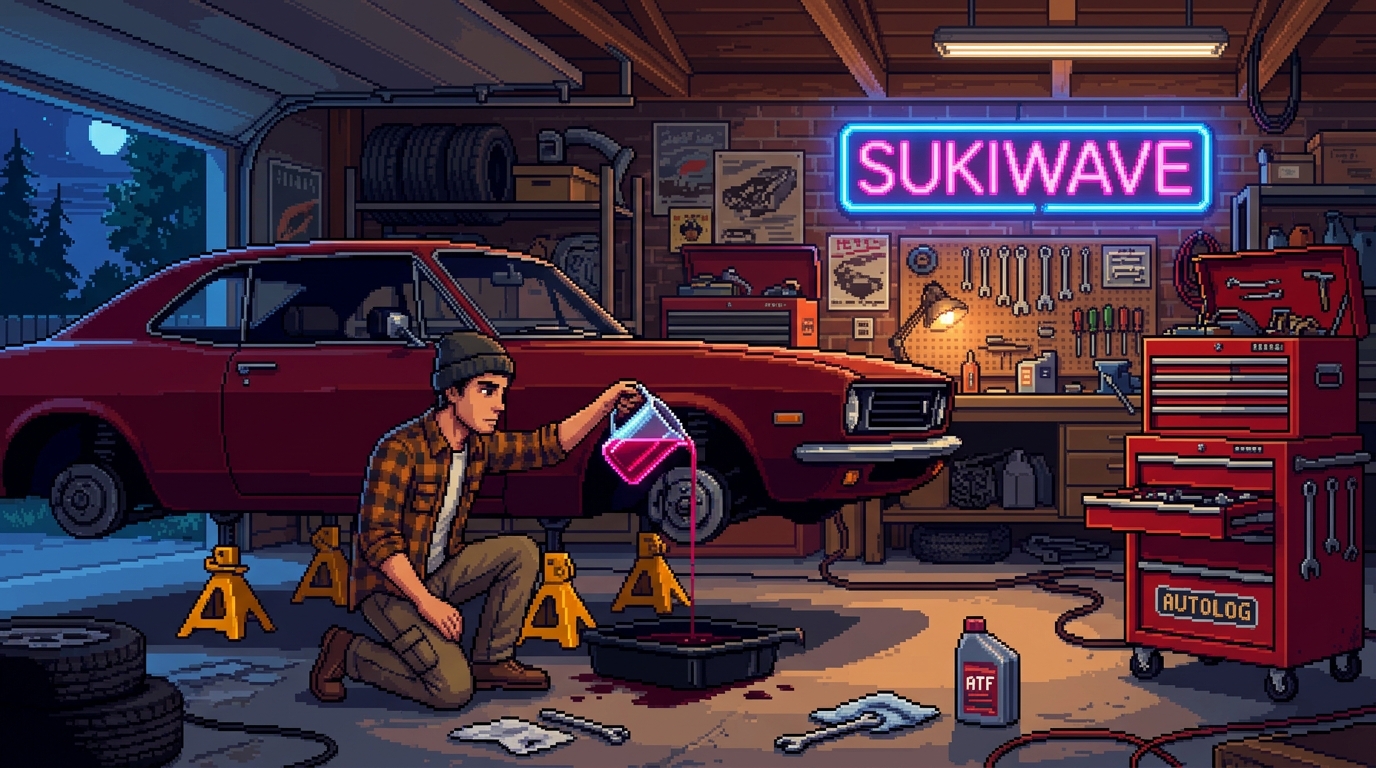
- The Safe Way (Gravity Drain & Fill): Simply pull the drain plug and let gravity dump whatever fluid is resting in the pan—usually 3 to 4 quarts (2.8 to 3.8 liters), leaving the rest in the torque converter. Measure the exact volume that drained out, install a fresh crush washer, and pour that exact volume of fresh fluid back in. Doing this 2 or 3 times across consecutive oil changes gradually refreshes the system safely without shocking the internal clutches.
A quick DIY warning: double-check your vehicle's specific fluid requirement before cracking that plug. Mixing up Toyota ATF-WS, Honda DW-1, or Ford Mercon LV is an express ticket to transmission purgatory. They are not universal, no matter what that cheap bottle at the gas station claims.
Notes from My Garage: The Hidden Problem for DIYers
A couple of years back, I tackled a drain-and-fill on my personal daily driver at 75,000 miles (120,000 km). Naturally, I followed the universal garage tradition: I removed the drain plug, accidentally dropped the magnetic bolt dead into the bottom of the catch pan, and gave my right arm a lukewarm bath in dark brown, burnt fluid while fishing it out with a magnet. Good times.
Once I cleaned up the driveway, I torqued the new crush washer down, poured in genuine OEM fluid, and felt the gearbox shift like silk. Pure mechanical satisfaction.
Fast-forward two years. I put the car up for private sale. A savvy prospective buyer showed up, pulled the Carfax, and pointed out a massive red flag:
"Carfax shows zero transmission maintenance on this car for 90,000 miles. Did you just ignore it?"
My heart sank. I had done three meticulous OEM drain-and-fills with factory fluid, yet because I spun the wrenches myself, Carfax stamped my transmission as completely neglected. I had to scramble through dusty glovebox folders looking for crumpled auto-parts receipts like a madman to convince him I wasn’t selling him a ticking time bomb.
The Solution: Enter AutoLog (The Vehicle Health Report)
That garage panic was the exact catalyst for building AutoLog.
When you spend your hard-earned Saturday taking care of your powertrain, you deserve credit for it—especially when it's time to sell. AutoLog is built specifically to kill the "Carfax Gap" for hands-on owners.
Instead of letting receipts fade in a shoebox, you open AutoLog and log your preventive transmission work in 30 seconds:
- The exact OEM fluid specification (e.g., Genuine Honda ATF DW-1)
- Drain plug torque specs logged (36 ft-lbs / 49 Nm)
- Volume measured (e.g., 3.5 quarts / 3.3 liters)
- Photo of your parts receipt and odometer reading
AutoLog takes your maintenance data and generates a clean, cryptographic-grade Vehicle Health Report. When a buyer asks why your transmission hasn't been serviced, you don't stammer—you hand them a professional digital dossier showing exact intervals, part numbers, and proof of care. You aren't just selling a car; you’re selling documented peace of mind for top-dollar resale value.
Documenting Your Drivetrain Care
Stop letting your meticulous maintenance go unnoticed while dealership fairy tales risk your gearbox. Whether you perform a drain-and-fill at home or rely on a trusted independent shop, logging your transmission service in a dedicated digital platform like AutoLog proves that your vehicle was maintained to last.
Disclaimer: This article is intended strictly for educational and informational purposes. Automatic and manual transmissions contain complex hydraulic, mechanical, and electronic components. Transmission fluid replacement requires strict adherence to manufacturer-specified fluid types, fill procedures, torque specifications, and operating temperature ranges. Introducing incorrect fluid or improper fill levels can cause severe mechanical failure or total transmission damage. Sukiwave and AutoLog operate solely as digital maintenance tracking and information platforms and assume no liability for mechanical failure, property damage, or personal injury resulting from actions taken based on this content.