You've probably thought about it. Or watched the debate kick off on a forum as the first November flurries drift across the highway.
You drive a front-wheel-drive hatchback, sedan, or compact crossover. The engine sits over the front axle. Steering happens up front. Drive power goes to the front wheels. Roughly 70 percent of your braking force lands on the front calipers.
Naturally, the budget math looks obvious: Why drop $800 to $1,000 on four dedicated winter tires when you could buy two for the drive wheels and leave all-seasons on the back?
It sounds smart. You save $400. The car pulls away from snowy intersections without spinning, and you get through winter on a budget.
Then you pull into Costco, Discount Tire, or an independent shop to get them mounted. The service advisor slides your keys back across the counter: "All four, or we don't install them." No exceptions. Even if you offer to sign a liability waiver.
It isn't an upsell. Tire technicians and collision repair shops see the aftermath of this setup every single winter.
When you put high-traction winter rubber on the front and leave slick tires on the back, the car becomes unstable the second the road curves.
What Tire Technicians Know That Drivers Learn the Hard Way:
- Why do tire shops refuse to install only two snow tires on the front?
Because mismatched grip causes snap oversteer. When you turn on snow, grippy front tires pull the car into the corner while hard rear tires slide out. The back end swings around before most drivers can react. - Doesn't front-wheel drive need power to the front to get moving?
Forward traction isn't the problem. Stopping and turning are. Gaining speed on packed snow is easy. Keeping the rear wheels planted around a bend at 35 mph (56 km/h) is where mismatched tires fail. - Can you put the two snow tires on the rear axle instead?
Tire makers generally put newer tires on the rear to prevent oversteer. But with dedicated winter tires on the back and all-seasons up front, the car simply refuses to turn. It plows straight ahead through intersections. With winter tires, it's four matched tires or nothing.
The Front-Wheel Drive Fallacy: Why Straight-Line Grip Lies to You
Drivers fall into this trap because human brains judge winter traction by one metric: Can I pull away from a dead stop?
Put two brand-new studless winter tires on the front of a Civic or a Corolla, and the car feels unstoppable. You step on the gas at an icy red light. The sipes pack snow against snow, the soft tread compound bites, and the car pulls forward without a flicker from the traction control light. You climb neighborhood hills while rear-wheel-drive trucks sit spinning in place.
It feels great.
It's also completely misleading. Accelerating in a straight line only asks for longitudinal grip. But driving isn't just pulling away from stoplights. You have to brake. You have to change lanes. You have to steer around corners. And in a corner, your rear tires have one job: keep the back of the car behind the front.
When sub-freezing temperatures turn your rear all-seasons into hard plastic, they can't do it.
The Pendulum Effect: How Traction Disparity Creates Snap Oversteer
It comes down to friction.
Winter tires use high-silica rubber that stays flexible well below 45°F (7°C), along with thousands of tiny sipes that grip packed snow. Standard all-season rubber begins stiffening near freezing, shedding lateral grip.
Take a gentle curve on a snow-packed road with winter tires up front and all-seasons out back:
- The front tires bite: You turn the wheel 15 degrees. The front tires grip immediately, pulling the front of the vehicle into the radius of the turn.
- The rear tires break loose: The rear tires need to hold the line against lateral centrifugal force. But with half the grip of the front, they break traction almost instantly.
- The pendulum swings: Over 60 percent of a front-drive car's weight sits over the front axle. Once the rear tires slide, that heavy front end acts as an anchor while the light rear end whips outward. Vehicle dynamicists call it snap oversteer.
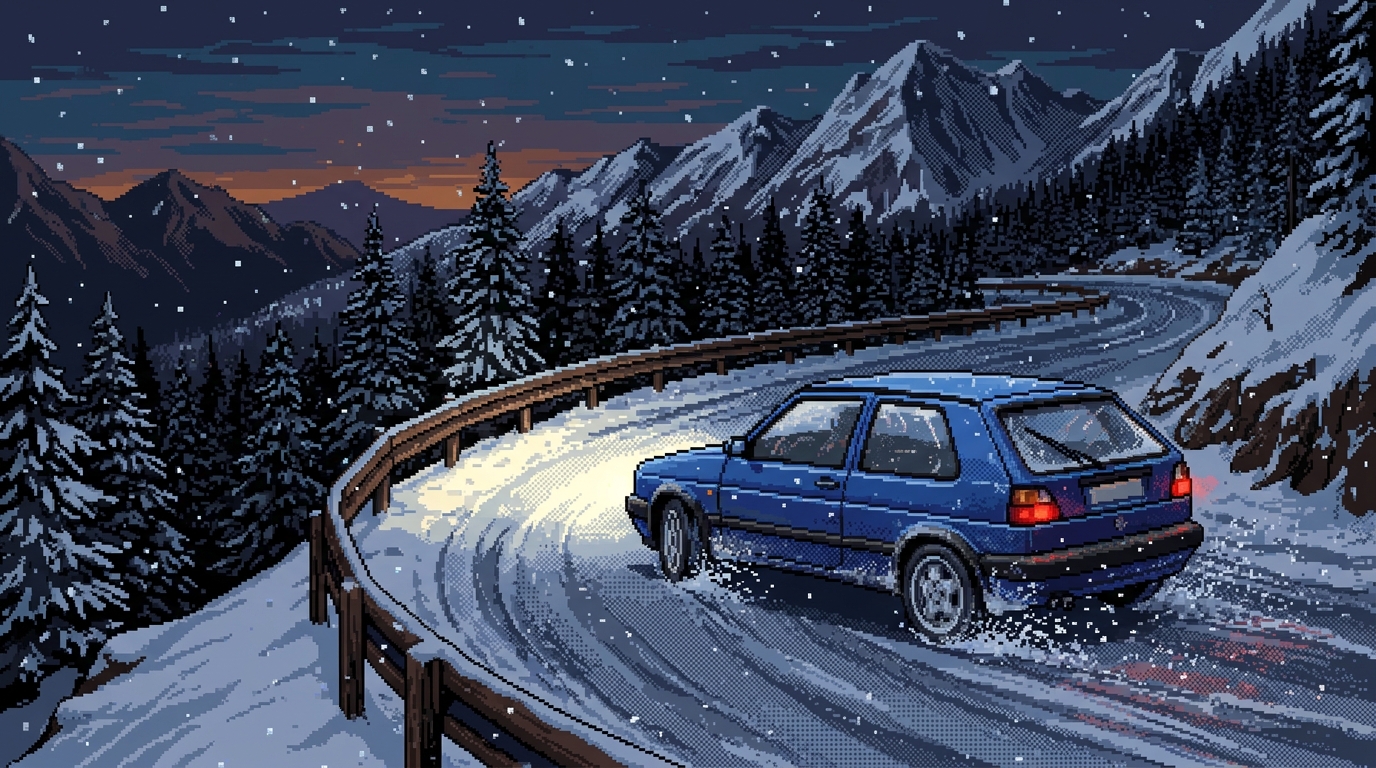
A sudden loss of rear traction causes snap oversteer when sticky front tires bite into a turn while slick rear tires break loose.
On dry pavement, a sliding car gives you plenty of warning. Tires squeal. Body roll builds gradually. On packed snow with mismatched axles, there is no warning. The car snaps sideways in less than half a second.
Unless you spend weekends drifting on frozen lakes, you aren't catching it.
The Driver Reflex: Why Hitting the Brakes Makes It Worse
Then comes the instinct.
The tail drifts. The driver panics. Foot comes off the gas and stabs the brake pedal.
On a car with four matching tires, anti-lock brakes and stability control might straighten things out. With mismatched tires, tapping the brakes seals the deal.
Braking forces forward weight transfer. The car's nose dives. Weight shifts onto the front axle, pushing the front winter tires deeper into the snow and increasing their grip.
At the exact same time, the rear suspension unloads. The downward force pressing the rear tires into the road vanishes.
Less downward load means less friction. Whatever microscopic grip the rear tires had left is gone. The rear end swings around immediately. Instead of sliding nose-first into a ditch, the car spins sideways into oncoming traffic or a guardrail.
The Rear-Axle Debate: Why Putting Two on the Back Won't Save You Either
There is always a counterargument:
"Tire manufacturers like Michelin and safety groups like Tire Rack say new tires should always go on the rear axle. Why not just mount the two snow tires on the back?"
For standard tires in wet conditions, that's correct. Rear tires need grip to keep the car tracking straight. An understeering car—one that pushes straight when you steer—is much easier for normal drivers to handle than an oversteering car that spins. You hit the brakes, scrub speed, and take the impact head-on.
With dedicated snow tires, though, putting them only on the rear creates terminal understeer.
Put two winter tires on the back and leave worn all-seasons up front:
* The rear of the car tracks straight and stays glued to the road.
* The front wheels have almost no grip for steering or braking.
Approach an icy corner at 30 mph (48 km/h). Turn the wheel. Nothing happens. The front tires glide across the snow while the car travels dead straight. Hit the brakes, and the ABS pulses uselessly as you slide through the intersection.
Here is the reality:
* Two snow tires on the front: The car spins out (Oversteer).
* Two snow tires on the back: The car won't steer or stop (Understeer).
Neither setup works. Mismatched winter rubber is an unnecessary safety hazard.
The Math: Saving $350 on Rubber vs. a $6,000 Totaled Vehicle
The garage math doesn't hold up.
Compare the numbers:
- Two quality winter tires: ~$300 to $400
- Four quality winter tires: ~$600 to $800
- Upfront savings: ~$300 to $400
Now look at a single low-speed slide into a curb at 20 mph (32 km/h):
- Bent lower control arm & tie rod: $450 to $700
- Cracked alloy wheel: $250 to $500
- Wheel alignment & steering inspection: $150 to $250
- Towing out of a snowbank: $150 to $300
- Body shop work (if you tap a guardrail): $1,200 to $2,500
- Insurance deductible: $500 to $1,000, plus higher premiums for three years
Saving $350 upfront to risk thousands in repairs makes zero sense. Tire shops refuse to mount two winter tires because their liability underwriters know these crash figures inside and out.
Practical Ways to Handle Winter on a Budget
Buying four new winter tires on factory alloy wheels can hurt your wallet. But you don't have to compromise on safety to keep costs down.
1. Pick Up a Set of Steel Wheels ("Steelies")
Mounting and balancing tires twice a year costs $100 to $160 per season. That's $200 to $320 every year. Over three seasons, mounting fees easily pay for a second set of wheels.
Look on Facebook Marketplace, Craigslist, or local junkyards for used 15-inch or 16-inch OEM steel wheels that match your bolt pattern. Downsizing wheel diameter allows you to buy taller-sidewall winter tires. They cost less, soak up winter potholes better, and let you swap wheels in your driveway in 30 minutes with a floor jack and torque wrench.
2. Switch to All-Weather Tires (3PMSF)
Don't want to swap wheels twice a year? Skip traditional all-seasons and buy certified All-Weather tires marked with the Three-Peak Mountain Snowflake (3PMSF) symbol. Models like the Michelin CrossClimate 2, Goodyear Assurance WeatherReady, or Falken Azenis use rubber that stays pliable in sub-zero freezes while holding up to 90°F summer pavement. One set. All year. No changeover fees.
3. Check Tread Depth Before the Snow Starts
If you have a set of winter tires in storage, don't assume they're good to go just because they have rubber left. Winter tires lose effective snow grip once tread depth drops below 4/32 inch (3.2 mm). Below that depth, the sipes wear away, leaving you with standard rubber. Check them with a simple gauge or the upside-down Lincoln penny test. If the top of Lincoln's head is fully visible, the tire is done for winter duty.
Actionable Weekend Wrap-up & Keeping Track of Your Seasons
Winter roads are unforgiving. Traction has to be balanced across all four wheels, or the car will pivot around the axle that loses grip first.
Take twenty minutes this weekend:
1. Measure tread depth on all four tires. Check sidewalls for cracks.
2. Set your cold tire pressures. Remember that tire pressure drops roughly 1 PSI for every 10°F drop in outside temperature.
3. If you need winter tires, plan for a complete matching set of four—or look into certified 3PMSF all-weathers.
Jotting down tire rotation dates, seasonal swap mileage, and tread depths in a free tracker like AutoLog takes the guesswork out of the season. When the first blizzard hits, knowing exactly how much grip you have left makes cold-weather driving a lot less stressful.
Disclaimer: This article is intended strictly for educational and informational purposes. Operating a motor vehicle on snow, ice, or sub-freezing roads involves inherent physical risks. Never mix different tire categories (such as pairing winter tires with all-season or summer tires) on the same vehicle, as severe handling instability and loss of vehicle control can result. Always consult your vehicle manufacturer's recommendations and adhere to state or provincial winter tire mandates. Sukiwave and AutoLog assume no liability for mechanical failure, vehicle damage, collisions, or personal injury resulting from maintenance decisions or driving actions taken based on this editorial content.