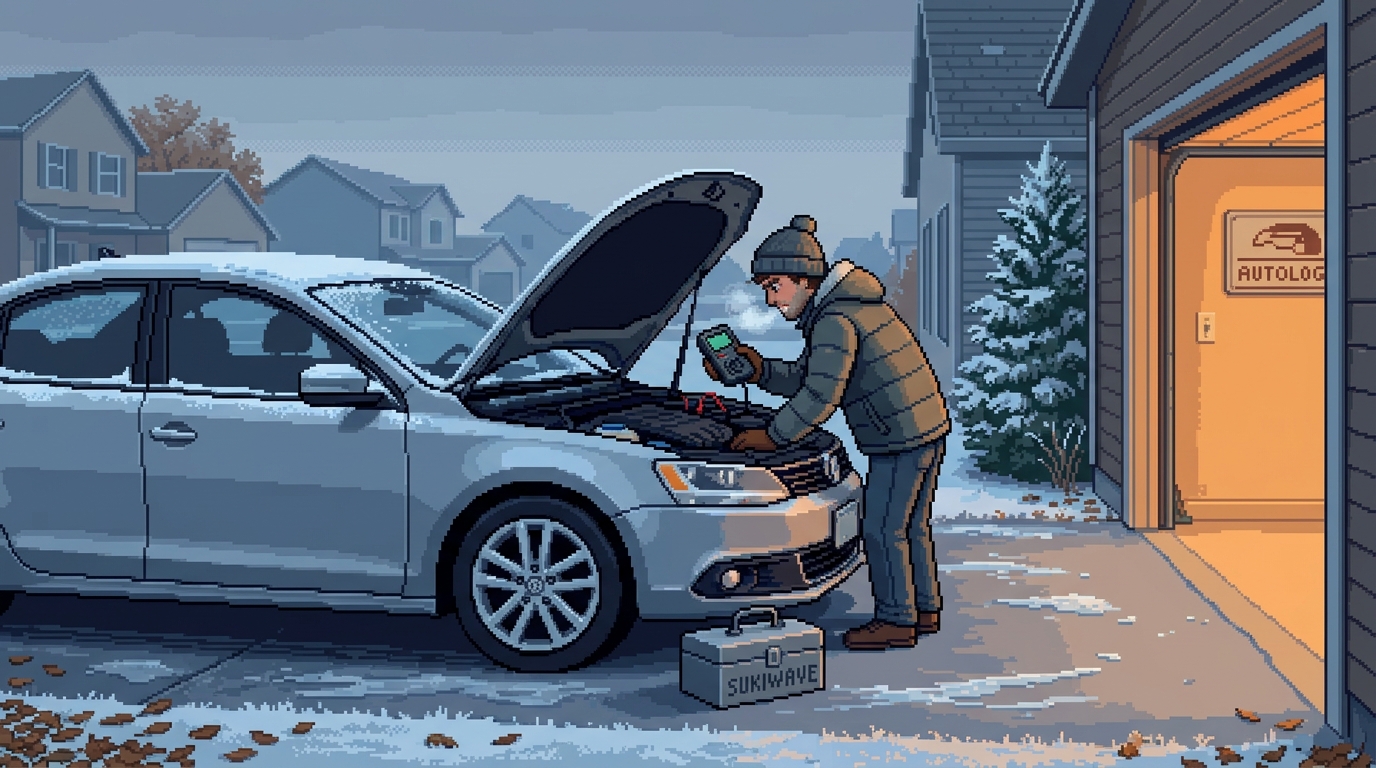
The season's first hard frost has a predictable way of catching drivers completely off guard.
You scrape the frost from the windshield, climb into the driver's seat, and turn the key or press the start button, expecting the engine to fire up exactly as it did yesterday afternoon. Instead, you hear a sharp, metallic click. Or worse, a frantic burst of rapid clicking from the fuse box, followed by complete silence. The dashboard screens flicker, the gauges twitch, and the car refuses to turn over.
It is easy to assume the freezing overnight temperature ruined an otherwise healthy battery. But in automotive service bays, technicians see this scenario every October and November: cold temperatures rarely create battery failure overnight. More often, the cold simply unmasks degradation that has been quietly developing for months.
The 30-Second Truth About Cold Battery Failure:
- Did the cold weather break my battery overnight? No. High under-hood heat during the summer causes the actual structural damage—corroding internal lead grids and boiling away electrolyte. Cold weather simply reveals how much capacity was already lost.
- Why did the car start with zero issues yesterday? Warm engine oil and relaxed engine tolerances require very few amps to spin the crankshaft. Even a severely degraded battery operating at 40% health can crank a warm engine without showing symptoms.
- Can I trust my digital multimeter reading 12.4 volts? Not for cranking capacity. That reading measures resting surface voltage with zero electrical load. When your starter demands hundreds of amps, high internal resistance causes that voltage to collapse instantly.
- Why does the dashboard make that rapid clicking sound? When battery voltage drops below roughly 10 volts under cranking load, the vehicle computer shuts off the starter relay to protect sensitive electronics. As soon as the load drops, voltage rebounds, the computer tries again, and the relay cycles rapidly on and off.
- What is the proper way to check battery health? A digital conductance load test. It measures actual Cold Cranking Amps (CCA) and internal plate resistance, giving an accurate assessment of remaining service life in under two minutes.
Why Summer Heat Causes the Real Damage
To understand why a battery fails on a cold morning, you have to look at what happens inside the casing during hot weather.
Automotive lead-acid batteries rely on positive and negative lead plates submerged in an electrolyte solution of sulfuric acid and distilled water. Electrical energy is produced and stored through a continuous chemical reaction between the active lead material and the acid.
While cold weather slows this chemical reaction down, extreme heat actively destroys the battery's internal structure.
During summer driving, temperatures inside an engine bay routinely climb above 140°F (60°C). That sustained heat accelerates three distinct failure mechanisms:
- Positive Grid Corrosion: The internal lead framework that supports the active material oxidizes at a much higher rate in extreme heat, thinning the grid metal and increasing electrical resistance.
- Electrolyte Loss: Even in modern sealed or "maintenance-free" batteries, prolonged high temperatures cause water vapor to escape through one-way safety vents, gradually concentrating the acid and exposing plate tops.
- Plate Sulfation: As active material sheds from corroded grids, hard lead sulfate crystals form across the plate surfaces. Over time, these crystals become permanent, permanently reducing the usable surface area available to generate current.
By late summer, a three- or four-year-old battery may have lost nearly half of its original plate capacity.
Now, here is why almost nobody notices:
When ambient temperatures are 75°F (24°C) or higher, motor oil flows easily, internal engine tolerances are relaxed, and a healthy starter motor may only require 120 to 150 amps for a split second to fire the engine. Even a badly degraded battery can deliver 150 amps briefly, masking its true condition throughout late summer and early autumn.
The Cold Weather Load: High Resistance Meets Slower Chemistry
When overnight temperatures drop below freezing (32°F / 0°C), two opposing mechanical and chemical factors collide the moment you turn the key:
1. Reduced Chemical Output
Battery power depends entirely on chemical reaction rates. As the temperature drops, the chemical reaction inside the electrolyte solution slows significantly.
At 32°F (0°C), a fully functional, brand-new lead-acid battery produces roughly 20% to 30% less cranking power than it does at room temperature. At 0°F (-18°C), available power drops by nearly 40% to 50%. The electrolyte becomes more viscous, ion transfer slows down, and the battery simply cannot discharge energy as rapidly.
2. Doubled Mechanical Resistance
At the exact moment the battery's output is compromised, the engine's power demand spikes.
Sub-freezing temperatures cause motor oil to thicken substantially. Even modern 0W- and 5W-rated multigrade synthetic oils present noticeable drag on rotating engine components when cold. The starter motor must force heavy crankshaft counterweights, connecting rods, and tight piston rings through cold, viscous fluid.
Instead of the 130 amps needed on a summer afternoon, the starter now demands 300 to 500 amps of instantaneous inrush current to turn the engine through its initial compression cycles.
When an engine demanding double the current is paired with a battery that lost half its physical plate area during summer heat and another 30% of its chemical speed to the freeze, the available power falls short of the demand. The starter stalls, and the electrical system drops offline.
The Multimeter Trap: Why Resting Voltage Misleads DIYers
One of the most common troubleshooting mistakes involves using a standard digital multimeter to test a no-start condition.
A driver touches the probes to the battery terminals and sees:
12.45 Volts.
The natural assumption is that the battery is fine, leading many owners to mistakenly replace expensive starter motors, ignition switches, or neutral safety switches.
Now, here is the catch.
A multimeter measures open-circuit voltage. Because the meter draws virtually zero current during testing, it only reads the static "surface charge" across the plates. Even a battery with severely sulfated, crumbling internal grids can register 12.4 or 12.5 volts if there is enough intact lead to establish a basic chemical potential.
Let's be clear: testing a battery with an unloaded voltmeter only tells you whether a circuit exists—not whether the plates have the muscle to spin an engine.
The problem occurs when a heavy current draw is introduced.
Every battery has an internal resistance (IR). As plates corrode and sulfate, internal resistance rises sharply. According to Ohm's Law, when a starter motor attempts to pull 350 amps through high internal resistance, an immediate voltage drop occurs across the battery terminals.
A battery showing 12.4 volts at rest can easily plummet below 7.0 volts the instant the starter solenoid engages.
The Starter Relay "Rapid Click": What the Vehicle Computer Is Doing
Modern vehicle electronics explain the rapid machine-gun clicking sound that accompanies many cold-weather battery failures.
Engine control modules (ECUs) and body computers require a steady power supply to operate safely—typically a minimum of 9.6 to 10.5 volts. If system voltage drops below that threshold, microprocessor logic becomes unstable, creating the risk of corrupted memory or erratic sensor readings.
When you turn the key on a weak battery:
- The computer signals the starter relay to close, sending power to the starter motor.
- The starter motor draws massive current, causing terminal voltage to instantly collapse from 12.4V down to 7V due to high internal plate resistance.
- The computer detects voltage falling below its safe operating limit and immediately cuts power to the starter relay to protect vehicle modules.
- With the starter load suddenly removed, battery voltage rebounds back up to roughly 11.5 volts.
- The computer senses adequate resting voltage once again and re-energizes the starter relay.
- The entire cycle repeats ten to fifteen times per second.
Let's be clear about what that sound actually is: that rapid clicking is not a mechanical failure of the starter motor or solenoid. It is the vehicle's electrical control system rapidly engaging and disengaging the circuit as voltage collapses under load and rebounds in open air.
How to Properly Test Cold Cranking Amps (CCA)
To accurately evaluate whether a battery can endure winter conditions, technicians rely on Cold Cranking Amps (CCA) testing rather than open-circuit voltage checks.
CCA is an established industry standard stamped on every automotive battery label (such as 650 CCA or 700 CCA). It defines the number of amps a 12-volt battery can deliver at 0°F (-18°C) for 30 consecutive seconds while maintaining at least 7.2 volts.
Professional testing uses one of two methods:
- Conductance Testing (Digital Analyzers): Handheld diagnostic analyzers pass a low-frequency AC signal through the battery cells. By measuring conductance and internal plate resistance, the tool calculates remaining CCA and overall state of health (SOH) in seconds without draining the battery.
- Carbon-Pile Load Testing: A heavy variable resistor applies an actual electrical load—typically half the battery's rated CCA—for 15 seconds while monitoring voltage retention on an analog meter.
Now, here is the good news: you do not need an expensive shop account to get an honest answer. Most local auto parts retailers and repair shops offer digital conductance testing free of charge in their parking lots. If a battery rated for 650 CCA tests at 320 CCA, it may start a warm vehicle today, but it lacks the reserve capacity to turn over a cold engine once temperatures dip below freezing.
Practical Pre-Winter Maintenance Steps
Taking a few straightforward precautions before the deep freeze sets in can prevent an unexpected tow call:
1. Check the Manufacturing Date Code
Look for the round numeric sticker or heat-stamped code on the battery casing (e.g., 03/22 or C-22, denoting March 2022). Standard flooded lead-acid batteries have an average service life of 3 to 5 years. Premium Absorbent Glass Mat (AGM) units often last 5 to 7 years. If a flooded battery is entering its fourth winter, scheduling a load test is a sensible precaution.
2. Inspect and Clean Terminal Connections
Corrosion forming around the battery posts—often appearing as a white, blue, or green crust—adds contact resistance directly in the starter circuit. Disconnect the terminals (negative cable first), clean the lead posts and clamps using a wire terminal brush with a mixture of baking soda and water, dry thoroughly, and apply a light coat of dielectric grease or protective terminal spray before reconnecting.
3. Eliminate Parasitic Current Draws
Modern vehicles maintain a continuous standby current (typically 20 to 50 milliamps) to power alarm receivers and module memories. Leaving aftermarket accessories plugged in—such as unswitched dash cameras, GPS units, or active OBD-II diagnostic dongles—can double or triple this draw, depleting a cold battery's reserve capacity overnight.
4. Maintain a Reliable Service History
Keeping accurate records of component ages eliminates the guesswork from seasonal maintenance. Receipts stored in glove compartments fade quickly, and battery warranty tags often become illegible from engine heat and grime. Using a straightforward digital platform like AutoLog makes it easy to log installation dates, CCA specifications, and seasonal test results, ensuring you know exactly when key components are nearing the end of their reliable service life.
A quick, two-minute battery health check before freezing temperatures arrive is one of the simplest and most cost-effective maintenance habits in automotive care.
Disclaimer: This article is intended strictly for educational and informational purposes. Automotive electrical systems carry significant amperage and risk of electrical shorts, burns, and personal injury. Lead-acid vehicle batteries contain corrosive sulfuric acid electrolyte and produce flammable hydrogen gas during normal operation. Always wear appropriate ANSI-rated eye protection and chemical-resistant gloves when inspecting or servicing vehicle batteries. Never introduce open flames or electrical sparks near battery terminals. Sukiwave and AutoLog assume no liability for mechanical failure, electrical damage, or personal injury resulting from actions taken based on this content.