
If you keep an eye on your fuel economy, even loosely, you've probably seen this. Somewhere in October or November, the trip computer that showed 32 MPG (7.3 L/100 km) all summer starts reading 29, then 27 (8.7 L/100 km). The engine runs fine. No warning lights. You're just stopping for gas more often.
This is usually the point where people start reading about O2 sensors and spark plugs. Hold off on that for now. Part of what you're seeing is the gas itself. What's sitting in the station's underground tank in November isn't the same blend that was in there in July.
So is the gas really different, or is it just the cold?
Both. Every fall, refiners switch to a winter recipe with more butane in it. Butane evaporates easily in cold air, which helps your engine fire up on a frosty morning, but it carries less energy than the heavier stuff it replaces. That alone costs you a couple of percent. Cold air, longer warm-ups, and low tires take care of the rest. A drop of around 10% is normal, and more than that on short winter trips.
And premium won't fix it. Octane isn't a measure of energy, and premium gets switched to a winter blend just like regular.
Yes, Gas Changes With the Seasons
Gasoline isn't one chemical. It's a mix of well over a hundred different hydrocarbons, and refiners adjust that mix depending on the time of year and where the fuel is going.
What they're adjusting is volatility, which is just how easily the fuel evaporates. In the US, the EPA caps it during the summer, and the summer rules at the pump run from June 1 to September 15. Canada sets its own seasonal limits by region through a national fuel standard, so the switch in Vancouver doesn't happen on the same schedule as in Winnipeg or Toronto. Either way, winter fuel works its way into stations over the fall as tanks get emptied and refilled, and by November it's pretty much all you can buy.
Nobody puts up a sign about it. The button still says 87.
Why Winter Gas Gets More Butane
An engine doesn't burn liquid gasoline. It burns vapor. The injector sprays a fine mist, some of it evaporates and mixes with air, and the spark plug lights that mixture. If the fuel won't evaporate, there's nothing for the spark to light.
In July that's easy. At 15°F (-9°C) it isn't. Cold fuel is slow to evaporate, and with a summer blend on a frosty morning you'd be cranking longer than you'd like while raw fuel just wets the cylinder walls.
Butane fixes that. It's the same stuff that's in a pocket lighter, and it boils at about 31°F (-0.5°C), so it turns to vapor even after the car has sat outside all night. Refiners add more of it in winter, which raises the fuel's vapor pressure. The industry measures this as Reid Vapor Pressure, or RVP. Summer gas is held to roughly 7 to 9 psi (48 to 62 kPa). Winter gas can go up to about 15 psi (around 100 kPa) in the coldest regions.
You wouldn't want that in August. In real heat, butane-heavy fuel evaporates too easily. Older carbureted engines could vapor lock, where bubbles form in the fuel line, the engine runs out of liquid fuel, and it stalls. Modern cars handle it better, but a lot more fuel vapor escapes into the air on hot days, and that vapor feeds summer smog. That's the reason the summer limits exist in the first place.
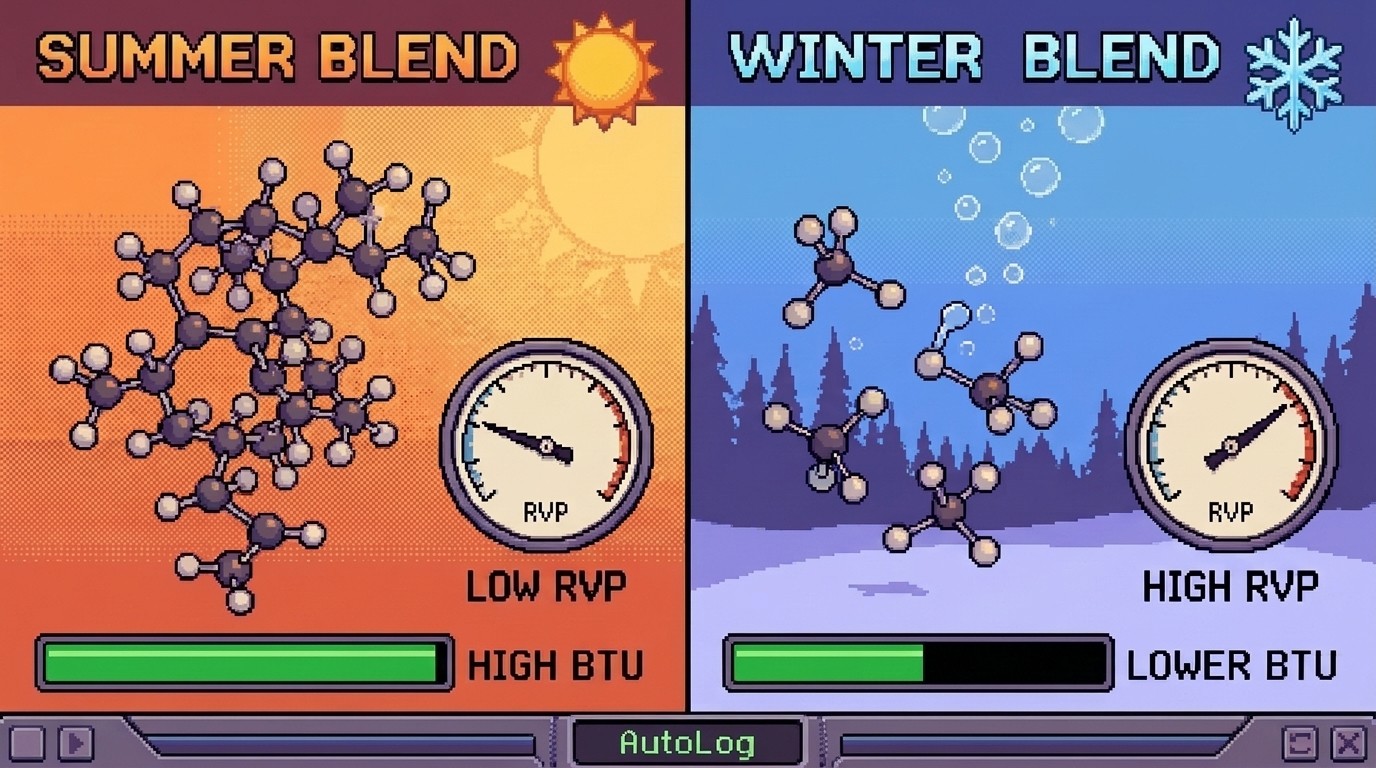
Summer gas leans on heavier molecules that stay put in the heat. Winter gas adds butane so it can still vaporize in the cold, and gives up a little energy in the process.
Where the Mileage Goes
Butane has less energy per gallon than the heavier hydrocarbons it replaces. It's not a huge difference, but it adds up. Depending on the blend, winter gas ends up with somewhere around 1.5% to 3% less energy than summer gas.
Your engine computer doesn't know or care what's in the tank. Its job is to give you the power your right foot is asking for. If each shot of fuel carries a little less energy, it sends a little more. That's your first couple of percent.
The rest comes from winter itself, and that's usually the bigger share. Air at 20°F (-7°C) is about 10% denser than air at 70°F (21°C), so at highway speed the car has more air to push out of the way. A cold engine runs rich for the first few minutes while it warms up, and the oil, transmission fluid, and wheel bearing grease are all thicker until they get some heat in them. Tires lose about 1 psi for every 10°F (5.6°C) drop, so if you haven't checked them since summer, they're probably low. Seat heaters and the rear defroster put more load on the alternator, too.
Add it all up and losing about 10% is normal. If most of your driving is short trips where the engine never fully warms up, 15% to 20% isn't unusual.
What About the Lower Price?
Butane is cheap, and making low-volatility summer gas takes extra refining work. Once refiners can blend in more butane, the gas costs less to make. In the US, that difference is usually estimated at up to 10 or 15 cents a gallon. If you buy gas by the liter, that's only about 3 to 5 cents a liter.
So the winter blend can be part of a fall price dip, but it's rarely the whole story. Crude oil prices, refinery problems, the end of summer road trip season, and plain old competition between stations on the same corner usually move the price more. If your local station dropped 15 cents a liter overnight, that's almost certainly the wholesale market or the station across the street, not the winter recipe.
Why Premium Won't Bring Your Mileage Back
Switching to premium is a pretty common reaction to bad mileage. It feels like better gas should go further.
It doesn't, because octane isn't a measure of energy. It measures how well the fuel resists knock, which happens when part of the fuel-air mix ignites on its own before the flame from the spark plug reaches it. High-compression and turbocharged engines need that resistance. An engine built for 87 doesn't, and putting 91 or 94 in it doesn't give the fuel any more energy to work with.
Premium also goes through the same seasonal switch. In November, premium is winter premium.
There's one small wrinkle. Depending on the brand and where you live, some premium gas is sold without ethanol. Ethanol has about a third less energy than gasoline, so fuel with none in it carries roughly 3% more energy than a typical 10% ethanol blend. You might see a small bump in mileage. That's the missing ethanol, though, not the octane, and at 20 to 30 cents more per liter (often 70 cents to a dollar more per gallon in the US), it doesn't come close to paying for itself.
If your fuel door or owner's manual says 87, stick with 87. If it says premium is required, use premium all year. Winter doesn't change either one.
When It's More Than Winter
A 10% dip that shows up every fall is normal. A 25% drop is worth a closer look, especially if the heater only blows lukewarm air after twenty minutes on the highway. That usually points to a thermostat stuck open. The engine never reaches full operating temperature, so the computer keeps it running rich the whole time. A sticking brake caliper can do it too. If one wheel is a lot hotter than the others after a normal drive, that's your hint.
All of this is easier if you know what's normal for your car. Jot down a few fill-ups this fall and next year you'll know right away whether a bad month is just November or something real. A notebook in the glovebox works fine. If you'd rather keep it on your phone, AutoLog lets you log fill-ups and maintenance for free, and that history is nice to have when you eventually sell the car.
This weekend, check your tire pressures first thing in the morning, before you drive anywhere. It takes five minutes, and of everything that eats your winter mileage, it's the one part you can actually get back.
Disclaimer: All content on AutoLog (sukiwave.com) is provided for informational and educational purposes only. Gasoline is extremely flammable and its vapors are explosive; always follow safety warnings at the fuel pump and use only the fuel grade and octane rating recommended in your vehicle owner's manual. While a moderate reduction in fuel economy is normal during cold weather and the seasonal transition to winter-blend fuel, never ignore an illuminated Check Engine Light (MIL), fuel odors, or a severe drop in drivability, as these may indicate mechanical faults requiring professional inspection. AutoLog is a web-based vehicle maintenance tracking application and does not operate physical repair facilities. Sukiwave LLC and AutoLog assume no liability for property damage, mechanical failure, or personal injury resulting from the use of this information.