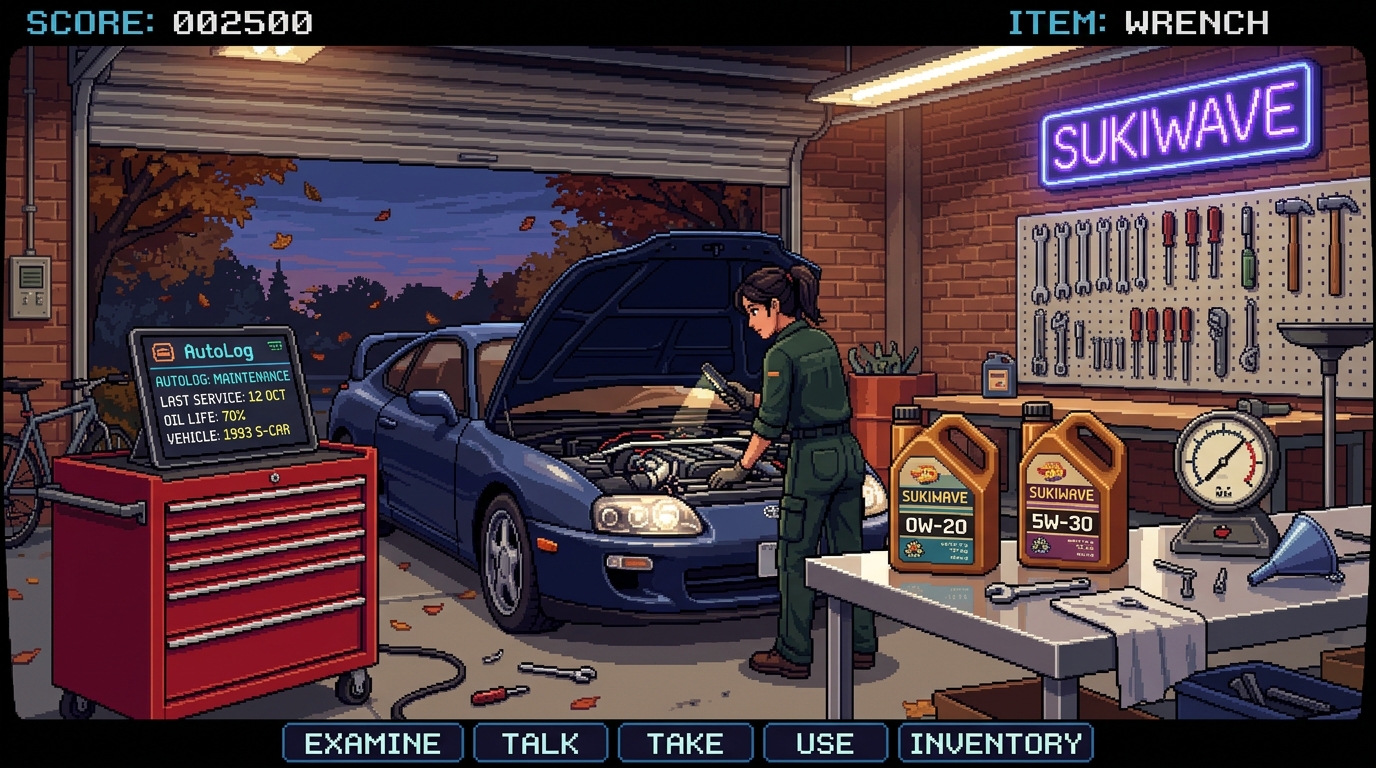
Every autumn across North America, as temperatures dip toward freezing and the smell of wood smoke fills the air, a familiar debate erupts at auto parts counters, online forums, and backyard garages.
An old-school mechanic or well-meaning friend leans over the counter and offers classic advice:
"Modern 0W-16 and 0W-20 oils are just water thin government fuel economy tricks. If you really want to protect your engine this winter, run thicker oil like 5W-30 or 10W-40. Thick oil creates a heavy cushion of protection."
It sounds intuitive. After all, thick honey seems tougher than thin water. If metal parts are rubbing together under heavy load, why wouldn't you want a thick blanket of liquid metal-cushioning armor?
Do not follow that advice.
Pouring heavier motor oil into a modern engine is one of the fastest ways to starve your valve train, trigger timing chain stretch, throw check engine lights, and turn a routine cold morning start into a $3,000 repair bill.
Here is the engineering truth behind why oil viscosities differ, how much deviation your engine actually tolerates, and why switching to thicker oil for high-mileage vehicles does more harm than good.
Key Takeaways (Quick Summary):
* Clearance Dictates Viscosity: Modern engines are machined with microscopic bearing tolerances (often under 0.025 mm). Heavy oil cannot physically wedge into these clearances during cold starts, causing metal-to-metal contact.
* The Hydraulic VVT Factor: Modern variable valve timing (VVT) sprockets and timing chain tensioners are hydraulic actuators that rely on precise oil pressure and flow rates measured in milliseconds. Heavy oil delays actuation and causes chain chatter.
* The "W" Number Matters in Winter: The first number (0W vs. 5W) dictates cold pumping viscosity (MRV). In freezing weather, 0W circulates in seconds, whereas 10W can take tens of seconds to reach critical overhead cams.
* Tolerance for Deviation: Running one grade off (e.g., 5W-20 instead of 0W-20) in an emergency top-off won't destroy your car, but significant jumps (like 10W-40) can trigger cam timing trouble codes and permanent wear.
* The High-Mileage Myth: High-mileage engines don't develop larger bearing clearances unless they are knocking on death's door. Burning oil is caused by hardened valve seals and stuck carbon rings—thick oil makes stuck rings worse. Use a High Mileage oil at your factory viscosity instead.
Why Different Cars Require Different Oil Viscosities
To understand why modern engines require thin synthetic oils, you have to look inside the crankcase of a 1980s V8 compared to a modern direct-injected 4-cylinder or twin-turbo V6.
Decades ago, manufacturing machinery cut engine blocks with relatively wide production tolerances. Journal bearing clearances between the crankshaft and connecting rods were often 0.002 to 0.0035 inches (0.05 to 0.09 mm). To prevent metal-on-metal contact across those wider gaps, engines required thick oils like 10W-40 or 20W-50 to maintain an adequate hydrodynamic wedge.
Today, computer-guided CNC machining finishes crankshafts and bearings with aerospace precision. Bearing clearances in contemporary engines are often tightened to 0.0008 to 0.0012 inches (0.02 to 0.03 mm)—less than half the thickness of a human hair.
The Physics of Hydrodynamic Lubrication
In a plain journal bearing, the crankshaft does not simply float on a pool of oil; it creates a high-pressure dynamic wedge as it spins:
* Thin oil flows rapidly: A 0W-16 or 0W-20 oil enters microscopic bearing gaps almost instantaneously upon startup.
* Thick oil creates resistance: Forcing a 10W-40 oil into a 0.02 mm bearing clearance is like trying to force cold honey through a hypodermic needle. Instead of lubricating, the oil shears heavily, generates excessive internal parasitic heat, and starves the bearing edges.
Low-Tension Piston Rings
Modern engines use ultra-low-tension piston rings to eliminate friction and maximize fuel efficiency. These lightweight rings rely on low-viscosity oil to drain freely through tiny microscopic oil return holes in the piston skirts. If you put heavy oil in these engines, the rings hydroplane over the oil film instead of scraping it back down into the pan, resulting in massive oil burning and fouled spark plugs.
The Cold Morning Nightmare: VVT and Timing Chains
The biggest victim of heavy winter oil isn't actually your crankshaft—it is your cylinder head and valve train.
Almost every engine built in the past 20 years features Variable Valve Timing (VVT)—known as VTEC, VVT-i, VANOS, Dual-VVTi, or EcoBoost Ti-VCT.
These systems use variable cam phasing sprockets controlled by electronic oil control solenoids (OCVs) with microscopic internal mesh screens. In addition, the long timing chains wrapping around overhead camshafts are kept taut by hydraulic timing chain tensioners powered purely by engine oil pressure.
What Happens at 15°F (-10°C) with Heavy Oil:
- The "W" stands for Winter: In a 0W-20 oil, the "0W" represents the oil's low-temperature pumping viscosity rating. A 0W oil remains liquid and pumpable down to -40°F (-40°C). A 10W oil, by contrast, becomes sluggish and molasses-like below freezing.
- The Dry-Start Delay: When you start your car after an overnight frost, your oil pump must pull cold fluid from the bottom of the oil pan and push it 2.5 feet up into the cylinder head. With 0W oil, full pressure reaches the camshafts in roughly 1 to 2 seconds. With 10W oil, that journey can take 10 to 20 seconds.
- Timing Chain Slap: While the hydraulic tensioner waits for thick oil to arrive, the timing chain runs loose. It slaps violently against the plastic guide rails, causing that distinctive cold-start "rattle" or "chatter" you hear on freezing mornings. Over a single winter, this repeated slap stretches the chain links and shatters plastic guides.
- VVT Lag and Check Engine Lights: The tiny hydraulic ports in the cam phasers cannot move rapidly with thick oil. The Engine Control Unit (ECU) commands a 15-degree timing advance, but the sluggish oil delays the cam phaser by 400 milliseconds. The ECU detects the timing mismatch and triggers DTC codes like P0011 or P0016 (Camshaft Position Timing Over-Advanced).
Is a Slight Deviation in Viscosity Safe?
Many car owners find themselves at a gas station or shop facing a dilemma: My manual calls for 0W-20, but the shelf only has 5W-20 or 5W-30. Will it destroy my engine?
The answer depends on whether you are adjusting the Cold Rating (W) or the Operating Temperature Rating (Second Number).
0W-20 vs. 5W-20 (Changing the Winter Number)
- At Operating Temperature (212°F / 100°C): Both oils have the exact same kinematic viscosity (around 8.5 to 9.0 centistokes). Once your engine is fully warmed up on the highway, a 0W-20 and a 5W-20 behave identically.
- In Cold Weather: 0W flows significantly better below 0°F (-18°C). Using 5W-20 in an emergency top-off or during mild autumn months will not harm your engine. In fact, many owner's manuals explicitly state: "If 0W-20 is unavailable, 5W-20 may be used, but replace with 0W-20 at the next scheduled oil change."
0W-20 vs. 0W-30 (Changing the Operating Number)
- At High Temperatures: A 30-weight oil is thicker at operating temp (approx. 10.5 to 11.5 cSt) than a 20-weight. In extreme summer towing conditions or continuous high-RPM track driving, a slightly heavier operating viscosity provides higher High-Temperature High-Shear (HTHS) protection.
- Fuel Economy Trade-Off: You will experience a 1% to 2% drop in fuel economy, and slightly higher operating oil pressures, but an occasional emergency fill will not ruin modern bearings.
What is NEVER Acceptable:
Jumping multiple categories—such as putting 10W-40 or 20W-50 into a vehicle specifically engineered for 0W-16 or 0W-20—is never safe. The extreme viscosity gap will starve upper cylinder components, overwhelm the oil pump relief valve, and void your factory powertrain warranty.
The High-Mileage Dilemma: Should You Switch to Thicker Oil After 100k Miles?
One of the most persistent myths in automotive maintenance is that once your car passes 100,000 or 150,000 miles (160,000 to 240,000 km), you must switch to thicker oil because "the engine has worn loose."
Mechanically speaking, that premise is completely false.
The Bearing Wear Reality
If your crankshaft journal bearings had worn out enough to require 10W-40 to fill the gap, your engine would already be knocking loudly and on the verge of throwing a connecting rod through the block. In modern engines properly maintained with clean synthetic oil, bearing wear at 150,000 miles is virtually undetectable with standard calipers.
The Real Causes of Oil Consumption in High-Mileage Cars:
- Hardened Rubber Seals: Valve stem seals, crankshaft main seals, and camshaft seals dry out and shrink over years of thermal cycling, allowing oil to seep into combustion chambers and drip onto driveways.
- Carbon-Fouled Piston Rings: Combustion blow-by causes burnt carbon and varnish to bake inside the tiny oil control ring grooves. When rings get gummed up and stick, they cannot scrape oil off the cylinder walls, burning a quart every 1,000 miles.
Why Thicker Oil Makes It Worse
Pouring thick 10W-40 into an oil-burning high-mileage engine makes stuck piston rings even stickier. Thick oil cannot easily circulate through the tiny drainage holes behind the oil control ring, accelerating carbon buildup and increasing oil consumption over time.
The Real Solution: Use High-Mileage Formulations at Factory Viscosity
Instead of changing your oil's viscosity grade, switch to a designated High Mileage Full Synthetic oil in your vehicle's factory-specified viscosity (e.g., High Mileage 0W-20 or 5W-20).
High-mileage oils contain specialized chemistry designed specifically for aging engines without altering fluid dynamics:
* Seal Swell Conditioners: Mild chemical esters that penetrate dried rubber seals, gently restoring their flexibility and stopping minor valve guide and main seal leaks.
* Extra Detergents & Dispersants: Heavy-duty cleaning additives that dissolve baked-on varnish around stuck piston rings, restoring their spring tension and compression seal.
* Anti-Wear Additive Boost: Elevated zinc (ZDDP) and molybdenum packages that provide emergency boundary protection on older cam lobes and rocker arms.
How to Protect Your Engine This Winter
- Verify Your Oil Filler Cap and Owner's Manual: Always run the exact viscosity printed on your oil cap (e.g., 0W-16, 0W-20, 5W-30). Automotive engineers spent hundreds of hours dyno-testing that exact fluid dynamics profile.
- Never Skip Winter Oil Changes: In cold weather, short grocery runs prevent the engine from reaching operating temperature (212°F / 100°C). Water condensation and unburned raw fuel accumulate in the oil pan, diluting the oil and accelerating sludge formation.
- Keep an Accurate Service Log: When mixing seasons, tracking the exact date, mileage, and oil specification used in your last service is critical. For those who prefer a clean, digital way to stay ahead of upcoming seasonal oil and filter intervals without rummaging through glovebox receipts, modern platforms like AutoLog provide an intuitive, zero-hassle way to log your specs and keep your maintenance history organized.
Treat your engine to the precise fluid it was engineered to breathe, and it will effortlessly start, run quiet, and protect your wallet through the harshest winter freeze.
Disclaimer: This article is intended strictly for educational and informational purposes. Engine design, tolerances, and lubrication requirements vary significantly by make, model, model year, and driving conditions. Always consult your vehicle's official owner's manual and manufacturer service bulletins before selecting or changing engine oil viscosities. Sukiwave and AutoLog assume no liability for mechanical failure, warranty denial, or property damage resulting from actions taken based on this content.